BoatRun - User Guide
One native app for rowing, coxing, coaching and erging. Two web tools for afterwards.
| What it is | Where you use it | |
|---|---|---|
| BoatRun | The app. Row, Cox, Coach and Erg modes in one. | iPhone or Android phone, in the boat, in the coach launch or on the erg |
| Analyser | Post-session analysis in a browser | PC (best) or tablet |
| Viewer | Live spectator map | Any browser, any device |
BoatRun is downloaded from the App Store on iPhone or Google Play on Android. Both versions are the same app with the same features. Analyser and Viewer stay as web pages you just bookmark, on any device.
Contents
- Getting started
- Mounting the phone
- Roles - Row, Cox, Coach, Erg
- Erg mode
- Signing in - Drive, Account, Apple
- What happens to your data
- Basic, Pro and Coach
- Heart rate monitor
- Recording a session
- Layouts and tiles
- Workouts
- Connect to coach
- Coach mode
- Demo modes
- Session log, exports and Sync with Drive
- Analyser
- Viewer
- Metrics reference
- Limitations and warnings
- Troubleshooting
1. Getting started
New to BoatRun? Start with the Quick Start. It walks you through installing the app, first-time setup, and recording your first session, for whichever role you are - Row, Cox, Erg or Coach. About five minutes, no settings to change.
This guide is the full reference. The two tables below are the parts worth reading on your first day out.
The status pills
Top of the screen in portrait or landscape:
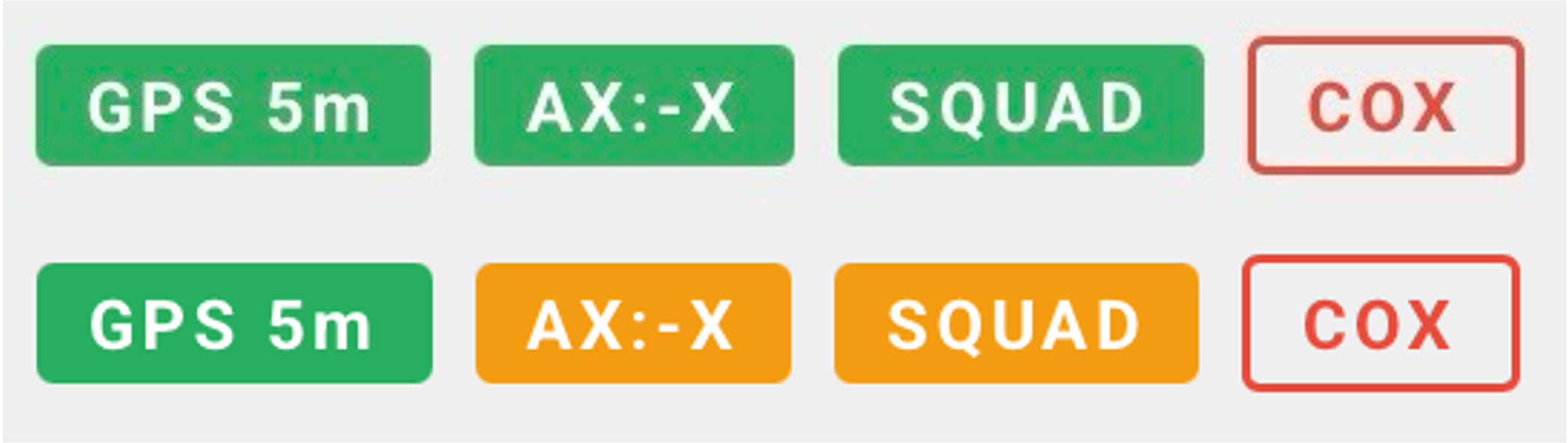
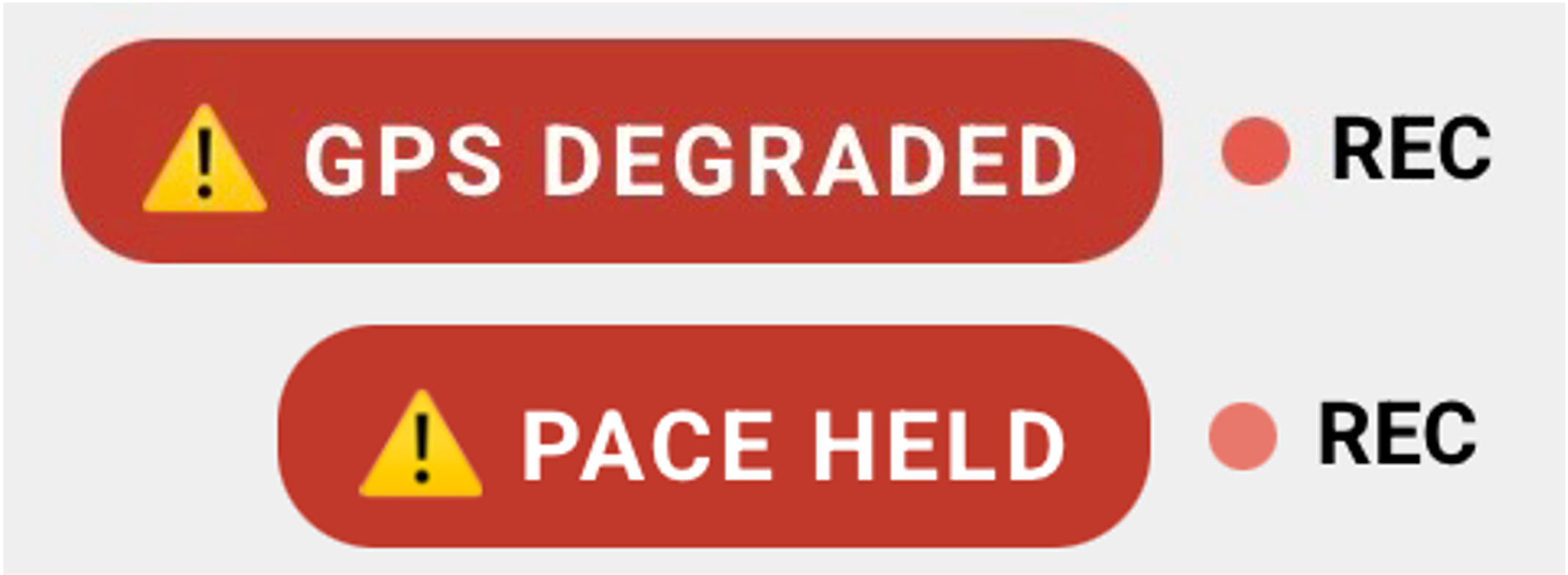
| GPS | Green = good fix. Orange = accuracy worse than 8m. Red = worse than 25m, pace suppressed. |
| ACC | Red means no accelerometer available - reopen the app. |
| AX:X / AX:Y | Which axis is being used for surge. Orange = detected but not locked. Green = locked, stroke detection live. |
| SQUAD | Orange when connected but no one watching. Green when coach / spectators watching. |
| COX | Only shows in Cox role. |
| GPS DEGRADED | The app cannot corroborate its speed reading against your position track, so pace, distance and DPS are not trustworthy at that moment. Clears itself within a few strokes once the phone has a clear view of the sky. |
| PACE HELD | A single GPS fix jumped more than 30% from your last good pace, which no boat can actually do. The app shows your last good pace instead of the spike. Clears itself within about 6 seconds. |
Common first-use problems
| Symptom | Fix |
|---|---|
| AX pill stays orange | Recalibrate with the phone in the mount and the boat still |
| CAL pill red | Restart the app and allow access to motion and orientation |
| GPS pill red | iPhone: Settings → Privacy & Security → Location Services → BoatRun → While Using, Precise Location on. Android: Settings → Apps → BoatRun → Permissions → Location → Allow while using, and turn Use precise location on |
| Nothing uploads | Tap the  button in the top bar and connect Google Drive button in the top bar and connect Google Drive |
| Recording stops at 20 minutes | You're on Basic. See Basic, Pro and Coach |
| Screen goes dark mid-row | Shouldn't happen - the app holds the screen awake. If it does, check Low Power Mode (iPhone) or Battery Saver and any adaptive battery setting (Android) |
| Water splash changes screens | Use the LOCK button to reduce errant touch detection. You will need to unlock to press LAP, change screens or end the session. For further protection, use Guided Access on iPhone (triple-click the side button) or Screen Pinning on Android |
2. Mounting the phone
Orientation
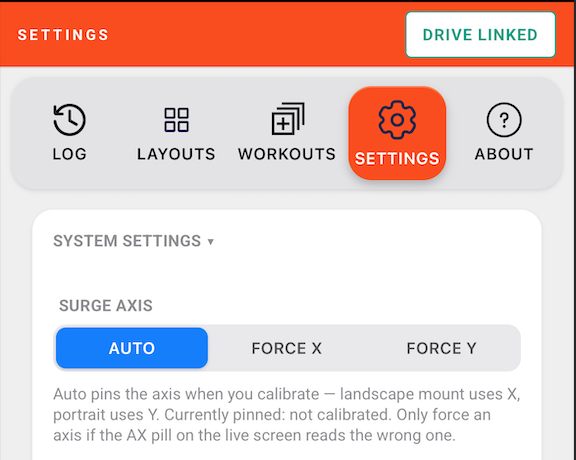
Portrait or landscape both work. What matters is that the phone is flat, screen up, and rigidly attached to the hull. The newer phones (iPhone 15 and newer, and most recent flagship Android handsets) have dual-band GPS which is significantly better at tracking. Due to the reflection of signal from water, carbon fibre and metal components, placing a rubber foam mat under the mount increases performance, particularly on older phones.
- Portrait - the app uses the Y axis for surge
- Landscape - the app uses the X axis for surge
Calibration works out which one you're using and pins it. You don't have to tell it anything. If the calibration fixes to the wrong axis, you can force a flip to another axis in system settings instead of keeping AUTO mode.
Tilt
Flat is best. The app measures your mount angle during calibration and compensates for it, but the compensation gets less reliable the further you go.
- 0–10° - no meaningful loss of accuracy
- 10–30° - works, accuracy degrades gradually
- Over 30° - not supported; the surge signal gets mixed with heave and metrics become unreliable
If the app detects that your current tilt is more than 8° different from your saved calibration, it will offer to recalibrate before you start. Take the offer - it takes 8 seconds.
Cox mode
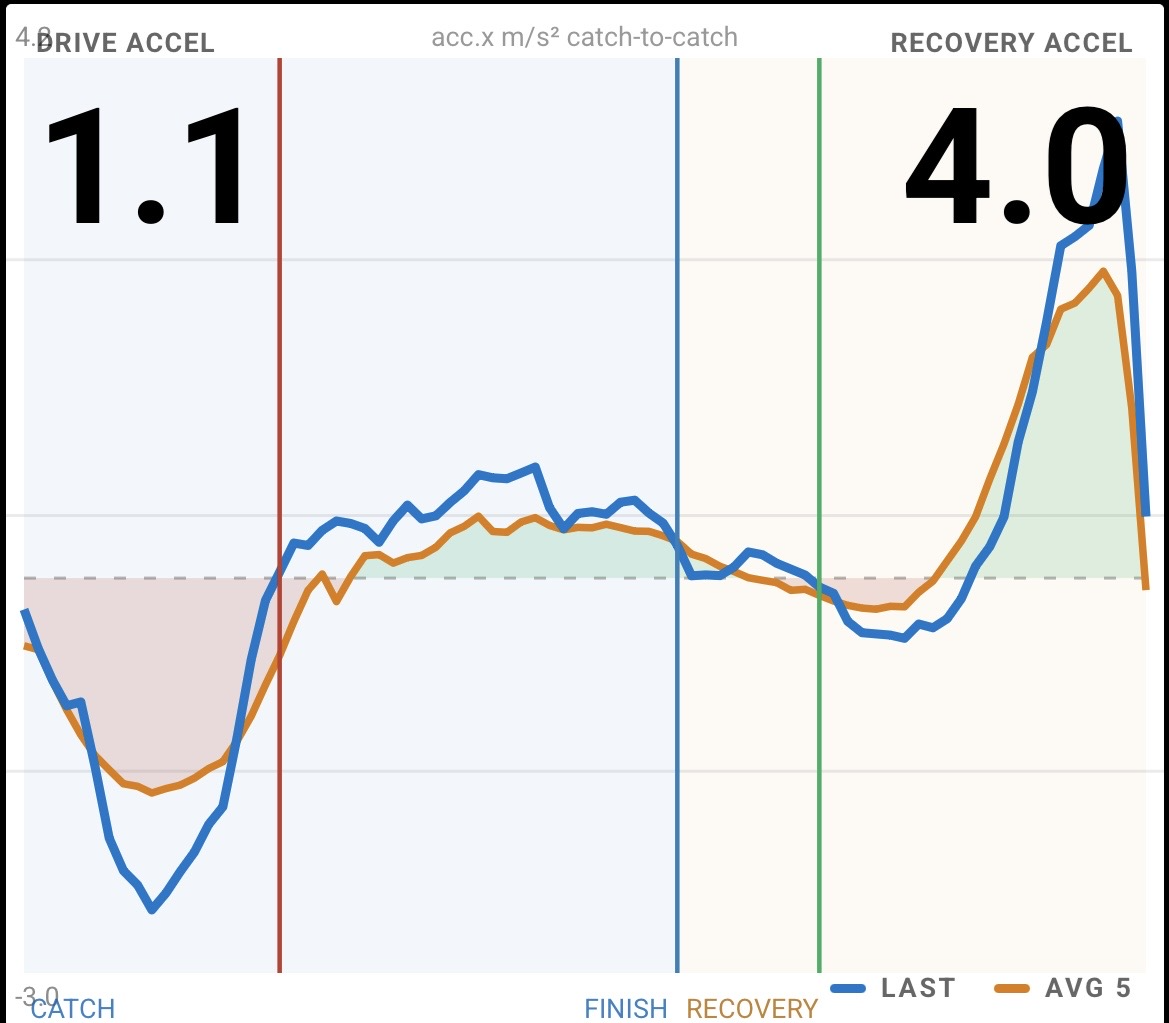
In Cox role the phone is facing the bow instead of the stern. If you fail to select cox mode, the primary indicator will be unusual stroke curves as shown here.
Position in the boat
Closest to the rigger gives the strongest stroke signal. Anywhere rigid is workable. What ruins it is a mount that flexes or rocks - any movement between phone and hull corrupts every accelerometer metric, and a mount that wobbles near stroke frequency will corrupt stroke ratio and Stroke Char specifically.
Recalibrate whenever you move the phone, change its angle, or switch boats.
3. Roles - Row, Cox, Coach, Erg
One app, four modes. Set at launch, changeable in HOME → SETTINGS → ROLE.
| Role | Tab bar | What it does |
|---|---|---|
| ROW | LIVE · CURVE · INTERVALS · HOME | Full recording, all metrics, stroke curve |
| COX | LIVE · CURVE · INTERVALS · HOME | Same as Row, with the accelerometer sign flipped for a bow-facing cox |
| COACH | COACH · HOME | Live squad map and rower tiles. No recording of your own. |
| ERG | ERG · CURVE · SQUAD · INTERVALS · HOME | Reads a Concept2 PM5 over Bluetooth. No GPS, no accelerometer - every figure comes from the erg. See Erg mode. |
You cannot change role while a recording is running - stop first.
Row, Cox and Erg all broadcast to a squad if a squad code is set. Coach mode receives.
The SQUAD tab only appears in Erg role, and only once you have actually joined a squad.
4. Erg mode
BoatRun talks to a Concept2 PM5 over Bluetooth. The phone is a second screen and a recorder - it is not measuring anything itself. No GPS, no accelerometer, no calibration. Every number you see comes off the monitor.
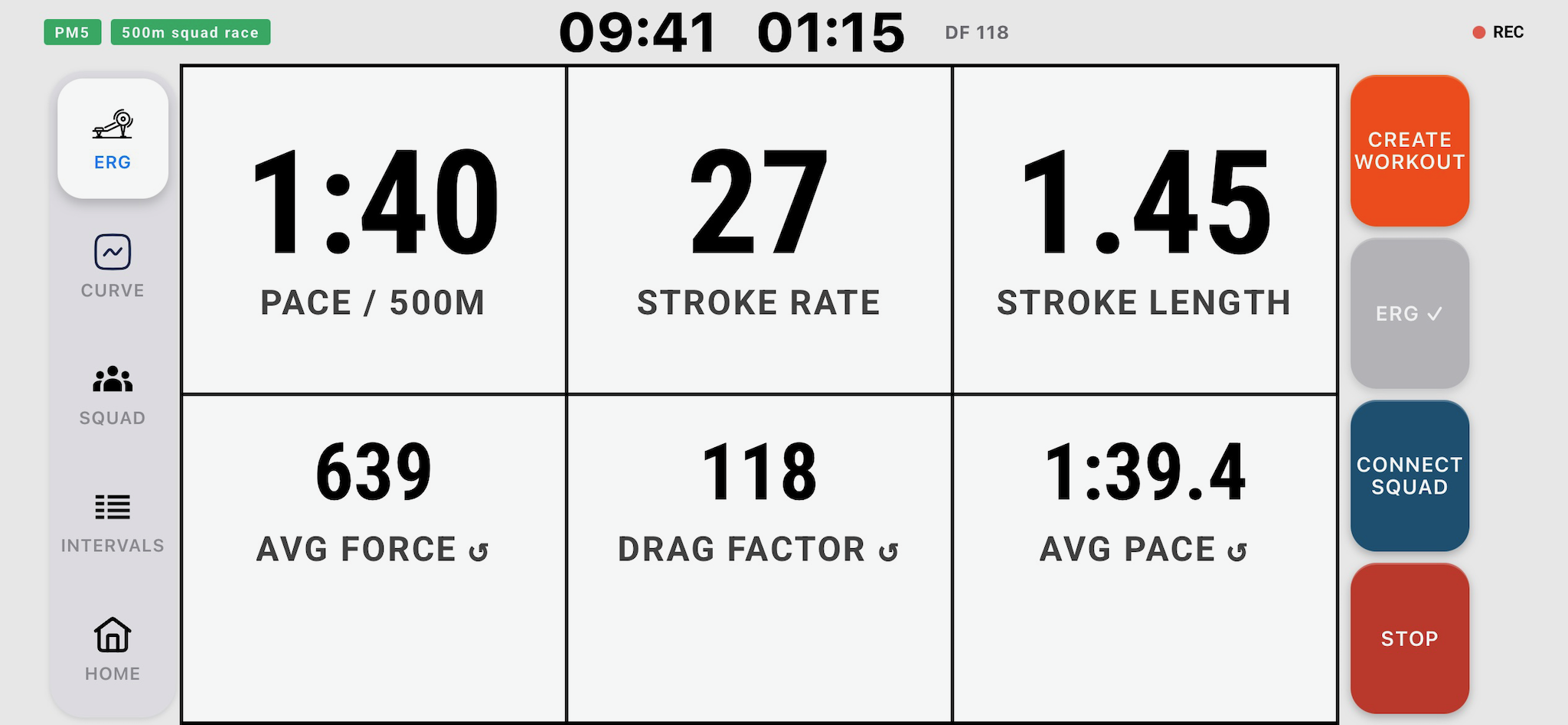
Governing principle: wherever the PM5 supplies a value, BoatRun displays it as-is. It does not recalculate pace, power or anything else. If your erg screen and your phone screen disagree, that is a bug worth reporting.
Connecting
HOME → SETTINGS → ERGOMETER (CONCEPT2 PM5) → CONNECT TO ERG, or the CONNECT ERG button on the erg live screen.
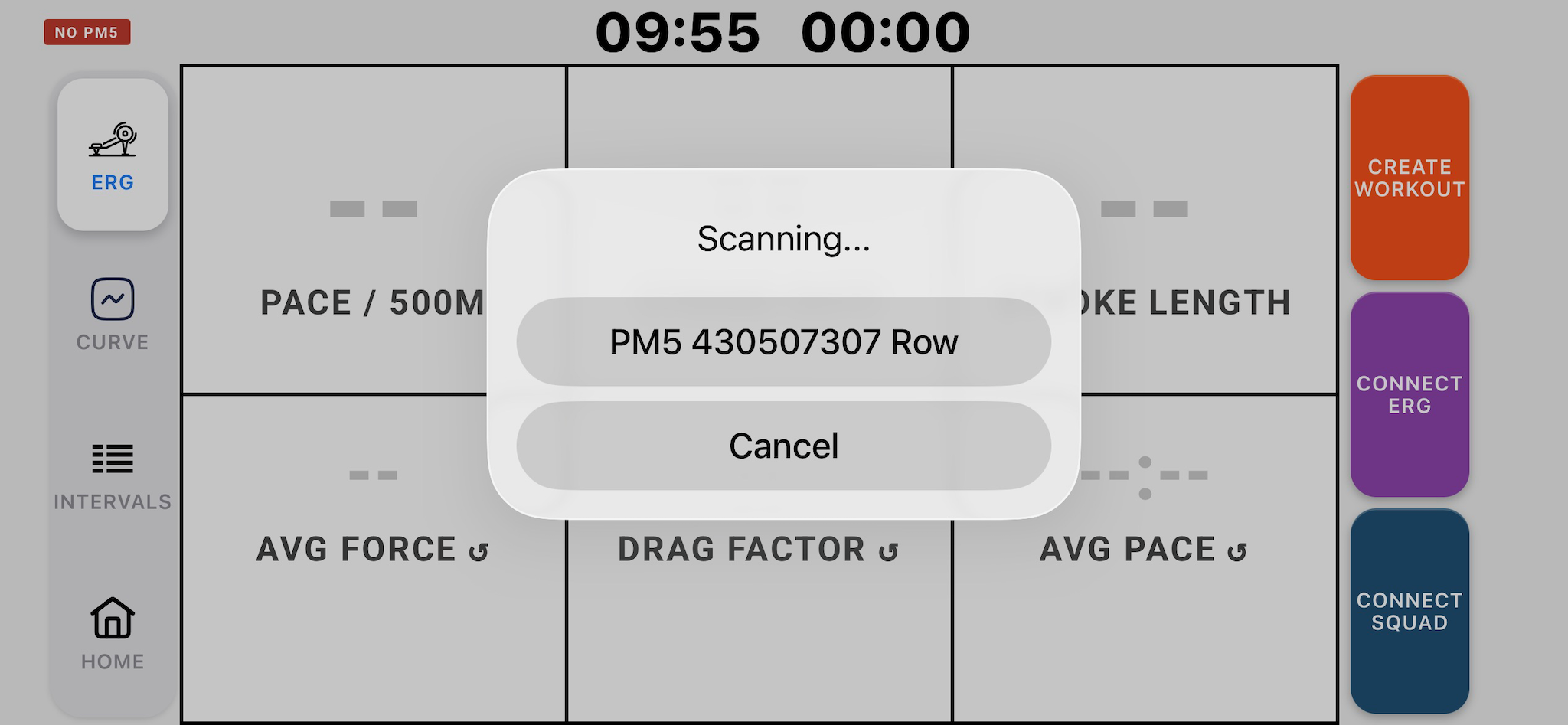
- Wake the PM5 first - press any key or take a stroke. A sleeping monitor does not advertise and will not be found.
- Tap CONNECT TO ERG and pick your PM5 from the list.
- Once connected the card shows live rate, watts and drag factor.
CONNECT ERG and CONNECT SQUAD both stay on the erg screen for the whole session. Connected ones turn green and become disconnect controls, so there is always a way back without going into Settings.
Heart rate - pair the strap to the erg, not the phone
Two Bluetooth links from one phone fight each other, and the strap always loses. So on the erg go to Menu → More Options → Utilities → Heart Rate and select your strap there. BoatRun then reads heart rate through the erg connection it already has, and everything downstream - session HR, TCX export, squad sync - works exactly as it would with a phone-paired strap.
The HR button is removed from the erg live screen for this reason. Once the PM5 has seen your belt once, BoatRun remembers the belt ID and asks the erg to re-pair itself on later connects.
PM5 heart rate updates about once a second, slightly coarser than a direct strap. Fine for erg work.
What is on screen
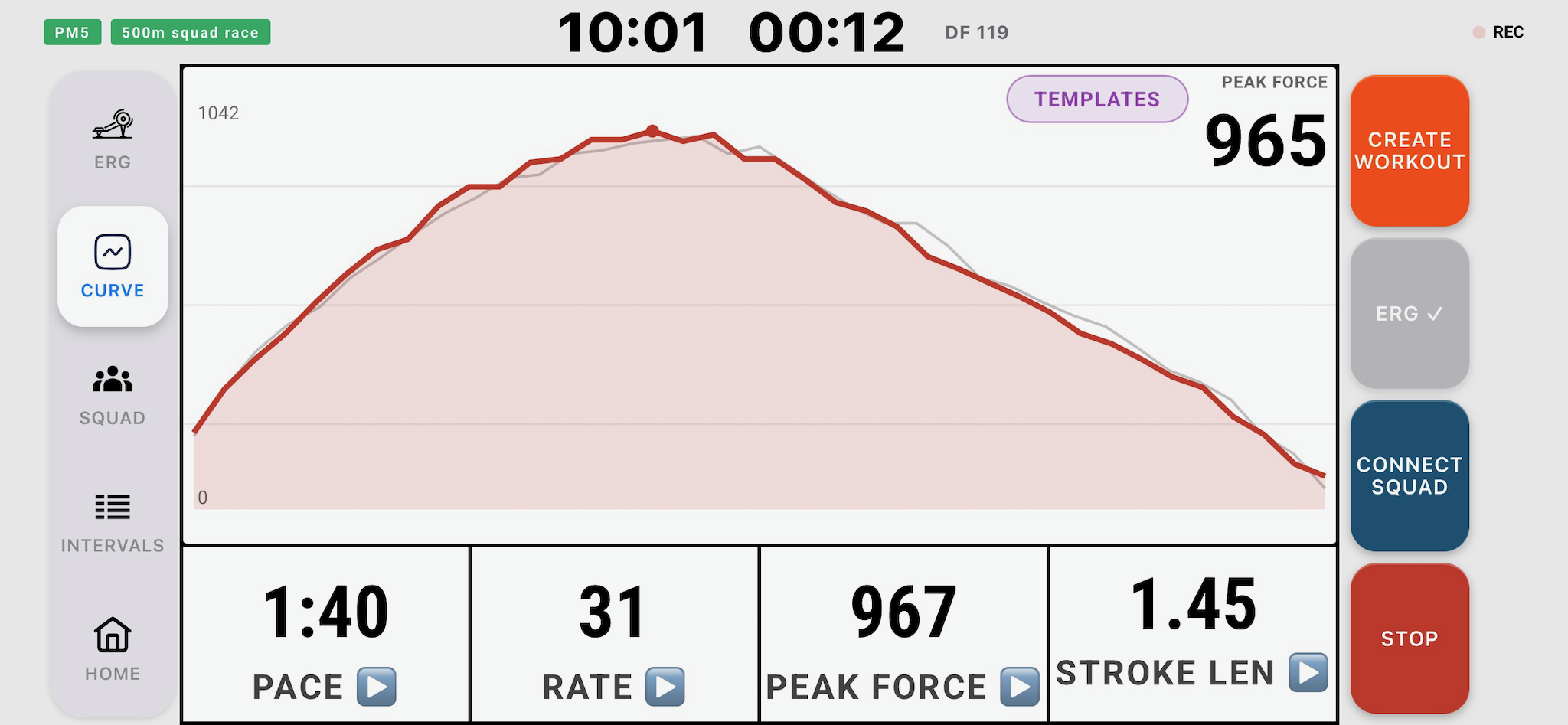
Distance is always in whole metres in erg mode regardless of your km/mi preference, because that is what the monitor shows. DF 124 beside the header distance is the drag factor - a setup reference, not a live metric.
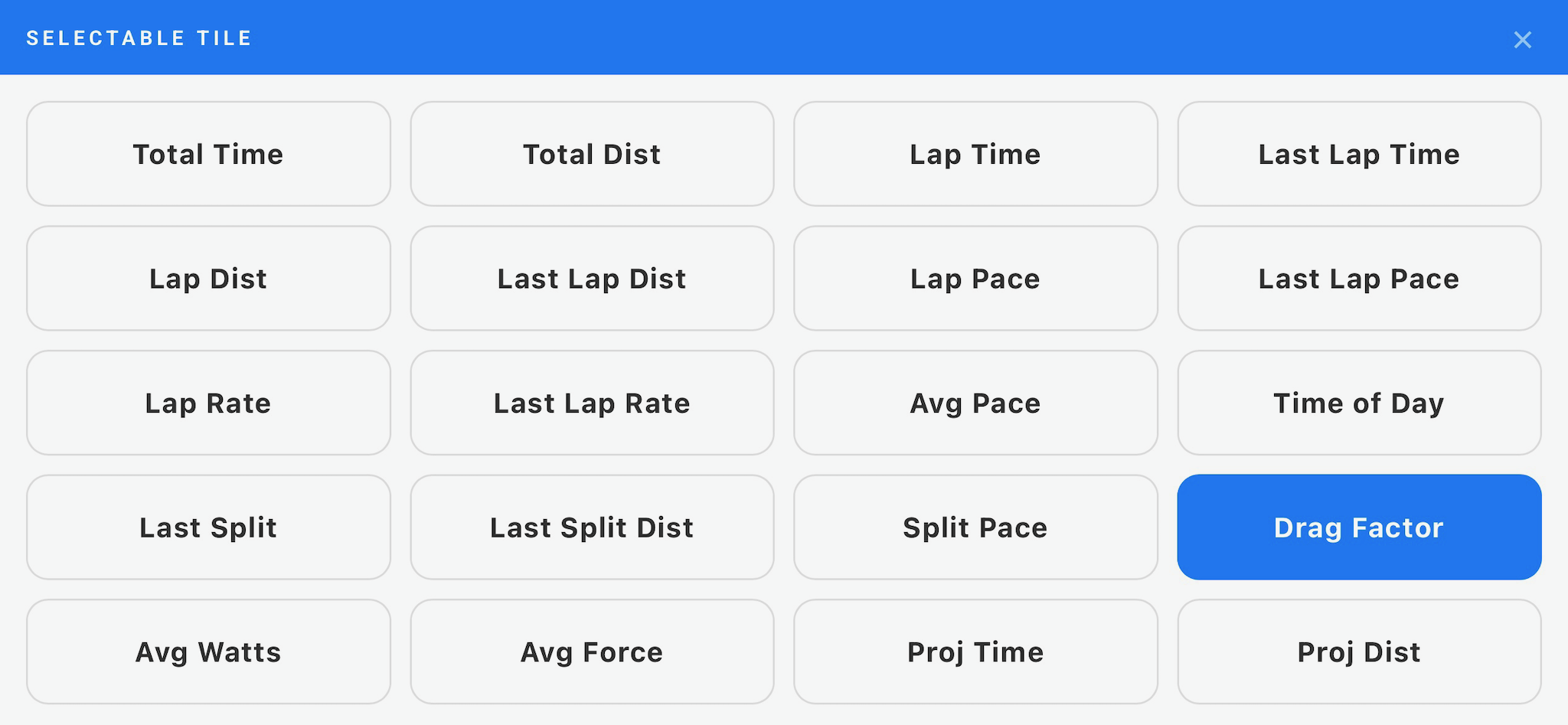
Erg tiles are instantaneous values: pace, rate, watts, drive length, peak force, calories, DPS, drive time, work per stroke, cal/hr, speed, recovery time, HR. Cumulative and averaged figures - split pace, average watts, average force, projected time, projected distance, last split, drag factor - live behind the selectable tile rather than taking permanent slots.
The CURVE tab on the erg
The erg curve is the PM5's own drive force curve in newtons - the drive phase only. It is a completely different quantity from the on-water acceleration curve, on different axes, so the two never mix. An erg stroke template will only draw over an erg curve, and an on-water template only over an on-water curve.
Force curve data is only requested while the CURVE tab is actually open. Polling it every stroke starves the Bluetooth connection and makes every other figure lag, so it is deliberately gated.
Workouts
Load a BoatRun workout the usual way and it is pushed onto the monitor. From then on the PM5 owns the timing - there is no 5-4-3-2-1 countdown screen, no lap summary card, no splash. The erg prompts you, and BoatRun follows along in the INTERVALS panel.
Workouts programmed on the erg itself are mirrored the other way: BoatRun reads the current interval's target off the monitor the moment the workout is armed, and tracks it. It cannot read the total number of reps for an erg-programmed piece, only the interval you are on, so it infers the pattern from the splits you have completed.
Limitation: a new workout programmed on the erg is only picked up when the monitor has returned to its ready state. Program a new piece without going back to ready and the old interval table may hang around.
Not every shape can be pushed. If a workout will not go across you get an explicit message naming the reason rather than silence.
The SQUAD tab - racing
Join a squad on the erg page or HOME → SETTINGS → SQUAD CODE exactly as an on-water rower would. A SQUAD tab then appears alongside CURVE.
Who needs what: joining a squad erg race or training event needs Pro. Setting one up - creating the race, pushing the workout, running the count-in - needs the Coach add-on. See Basic, Pro and Coach.
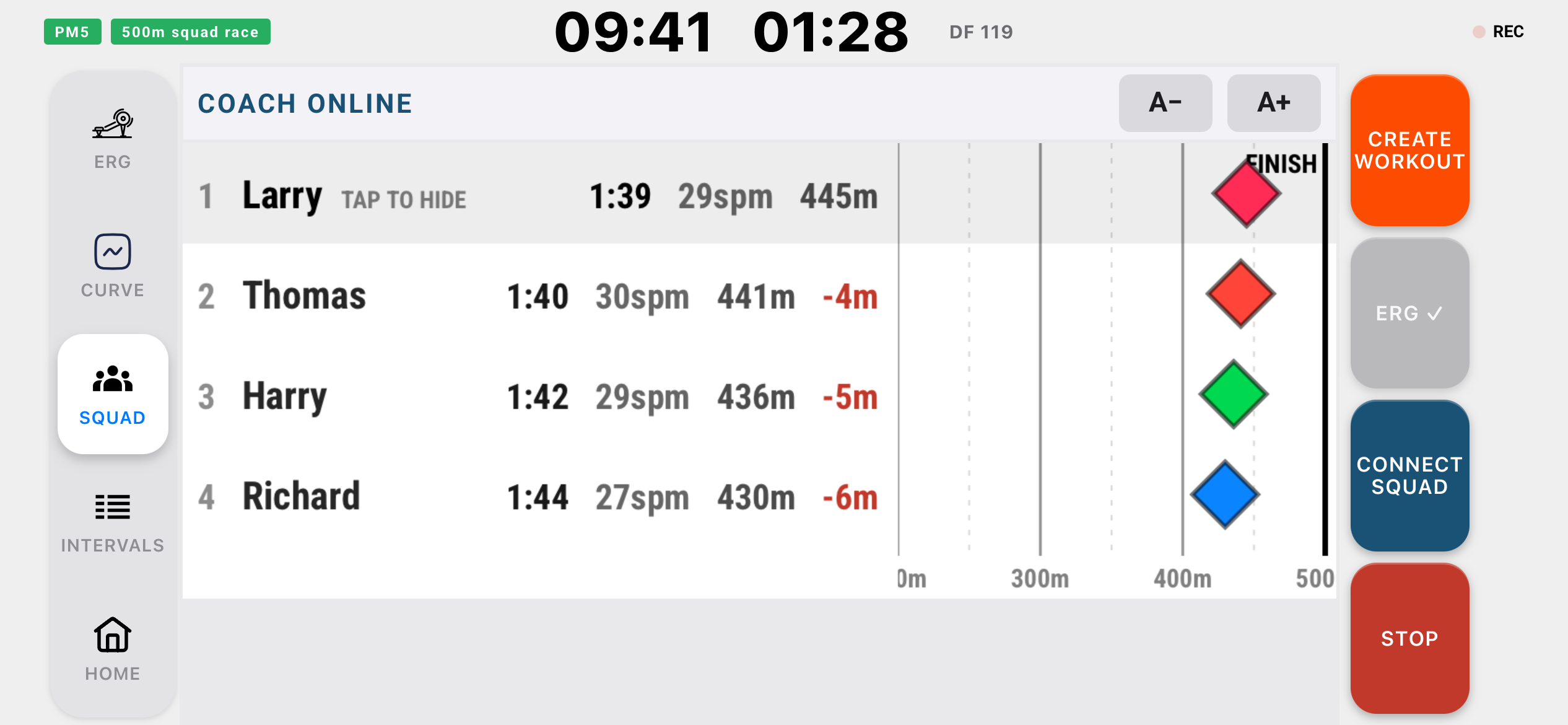
How a squad piece runs:
- Warm up however you like. When you are done, press menu to finish your warmup session. You MUST be on MENU to receive the workout
- Your phone shows WORKOUT RECEIVED. Your workout is now ready to go.
- The coach starts everyone together with a count-in of about 15 seconds.
During the race the SQUAD tab shows a simulated track with every rower's boat, plus name, pace, rate and the gap in metres ahead (+) or behind (−) you. Everyone resets to 0m during rest.
- Relative position needs a coach online and a comparable piece. Time intervals compare metre for metre; distance and calorie pieces cannot, so those fall back to pace and rate only.
- Tap your own name to hide yourself. It is a two-way trade - the squad loses sight of you, and you lose sight of their positions and gaps. Your coach still sees everything. Tap again to rejoin.
Erg data afterwards
Erg sessions save, sync and export like any other session. The Analyser converts the PM5 force curves onto its normal curve grid at load time, so curve comparison, group averages and the video overlay all work - the axis simply reads force in newtons instead of acceleration. Speed integration is skipped, because integrating newtons would produce nothing meaningful.
If something looks wrong
Beta builds have SETTINGS → ERGOMETER → RAW PACKETS, which shows every incoming packet with its byte length, hex and decoded values. If a tile reads oddly, open that, compare against what the erg’s own screen says, and send the dump with the feedback - hex plus two known values is enough to pin the problem exactly.
5. Signing in - your account and your storage
There are two of these and they do genuinely different jobs. Once you see the difference it stops being confusing:
- Your BoatRun account - who you are. Carries your subscription.
- Your Google Drive - where your files go. Storage, not a login.
You can have one, both, or neither.
Your BoatRun account
HOME → SETTINGS → ACCOUNT → ACCOUNT & PLAN…
Two buttons, either will do:
- Continue with Apple
- Continue with Google
Pick whichever you prefer. What the account is for:
- It carries your subscription between the app and the Analyser
- It's how the Analyser knows you've paid to unlock the features
Without linking your account, a subscription bought on your phone stays on that phone and the Analyser won't recognise it.
Adding the second provider. Once you're signed in, the panel offers to link the other one - Apple if you signed in with Google, Google if you signed in with Apple. Optional, and it takes one tap. Worth doing: it's a spare key to the same account if you ever lose access to the first.
Do it deliberately, because your Apple ID and your Google account almost certainly use different email addresses, so they are not recognised as the same person automatically.
Your Google Drive
The button in the top bar. This is not a second account - it's you granting BoatRun permission to write into a private folder inside your own Google Drive.
- Every finished session uploads there automatically
- The folder is hidden - it does not appear in your normal Drive file list, and no one can read it or access it except you
- The Analyser is the only other thing that can manage that folder, once you sign in to the same Google Drive account
- Skip Google Drive sync and sessions live only on the phone, or are exported from the app via TCX, FIT or JSON
Recommendations
- Connect Drive first. This is the one that protects your data - without it there's no backup and the Analyser has nothing to open.
- Then sign in to your BoatRun account, with whichever of Apple or Google you prefer.
- Then link the other provider. One tap, spare key.
- If you only ever do one thing, do Drive.
6. What happens to your data
| Where | What's there | Who can see it |
|---|---|---|
| Your phone | Every session, full detail. Raw motion and GPS traces in a local database. | You |
| Your Google Drive | A copy of each session, plus a small index of them, in a private hidden app folder | You. BoatRun writes there, recovers sessions from there, and deletes from there - one session at a time from the LOG, or the lot via SETTINGS → YOUR DATA. The Analyser reads the same folder and can delete individual sessions too. |
| Squad cloud (while connected) | Live rate, pace, position, and the metrics your coach has enabled | Your coach and anyone with the squad code |
| Squad cloud (if you tap Send to coach) | The full session file | Your coach and anyone with the squad code, until pruned |
| Strava (Pro, if linked) | The activity, as a TCX upload | Per your Strava privacy settings |
| Analyser | Your Personal Bests, tile order and units | You, once signed in to your Google Drive |
Live squad data
Only sent while you have a squad code set and connected. Disconnect in Settings and nothing leaves the phone. Position and metrics are sent - treat a squad code like a shared password.
Clearing things out
Everything lives under HOME → SETTINGS → YOUR DATA.
- STORAGE… - the safe one. Reports what BoatRun is using and offers to free space without deleting anything. Full detail below.
- DELETE MY DRIVE DATA - permanently deletes every BoatRun session in your Drive. Sessions on the phone are untouched.
- PRUNE SQUAD SESSIONS (Coach mode only) - removes squad cloud records older than 21 days for the squad code you are connected to.
- Deleting one session - swipe it left in the LOG, or use the trash icon in the Analyser. This deletes it everywhere. See below.
Deleting and freeing space are now two different things. STORAGE… frees space and loses nothing. DELETE removes the session for good, on every device. If all you want is room on the phone, never use DELETE.
Sync with Drive
The ☁ Sync with Drive button at the top of the session log brings down every session in your Drive that this phone doesn't already have. That's how you set up a new phone, or recover after reinstalling the app.
The first sync on a new device has to fetch every session in full and can take several minutes on a large archive - it will tell you how many it's about to download and let you back out. Do it on wifi and leave the app open while it runs. Afterwards it's near-instant, because the app keeps a small index in your Drive and only fetches what's actually new.
Your Drive copy is the one that always survives. Phones reclaim storage when they get full, and iOS can clear an app's cached data - if that happens, the session detail is simply fetched back from Drive when you open it. As long as you're signed in and syncing, nothing is lost.
How sessions are stored on the phone
A full session - every stroke, every acceleration curve, the GPS track - is around three quarters of a megabyte. A season of rowing is tens of megabytes, far more than the small, fast store the session list is drawn from can hold.
So BoatRun splits every session in two the moment it is saved:
- A summary - date, distance, time, average pace, stroke count. A couple of hundred bytes. This is what the LOG list draws, and every session you have ever recorded keeps one, forever.
- The full session - all the stroke and GPS detail, held in a separate database on the phone and loaded the moment you open that session.
You should never notice this. The log opens instantly however many sessions you have, and tapping one loads the detail straight off the phone - no network needed, so it works mid-river with no signal.
Freeing up space - SETTINGS → YOUR DATA → STORAGE…
This is the one button to know about. It first reports what BoatRun is actually using:
- Total in use, and what share of the space the phone is willing to give the app
- How many sessions are in the log, and how many of those still have their full copy on the phone
- How many of those full copies are backed up on Drive, and how many are the only copy on this phone
- Raw sensor traces and export data held separately, and leftovers from older versions of the app
Then it offers to free space. It removes the on-phone copy of sessions that are older than 30 days and confirmed present in your Drive, and tells you roughly how much that will save before you agree to it.
Nothing is deleted. Every one of those sessions stays in your log exactly as before. Open one and it downloads again from Drive - which does mean you need signal and a linked Drive to reopen an older row. Anything from the last 30 days is left whole on the phone, because that is the stretch you are most likely to want at the shed with no reception.
A session that is not on Drive is never touched, however old it is - for those the phone holds the only copy. If the report warns you that some sessions exist only on this phone, sync before freeing space.
If there is nothing old enough to free, it simply says so.
If the phone fills up anyway
BoatRun will not let full storage cost you a session. If it can't fit one when you press FINISH, it works through these steps on its own, in order:
- Strips the raw GPS/IMU trace data from stored sessions - every displayed metric and every export is unaffected; this only drops the debug-level trace.
- Removes the on-phone copy of already-synced sessions, oldest first, stopping as soon as there is room. Those sessions stay in the log and come back from Drive when opened.
- If there is still no room, the session is kept safe in an autosave slot rather than being lost, and you are told to free space and press Finish again. Do not close the app at that point.
Unsynced sessions are never removed automatically. Connect Drive and keep it syncing, so this process always has something safe to clear.
Deleting a session
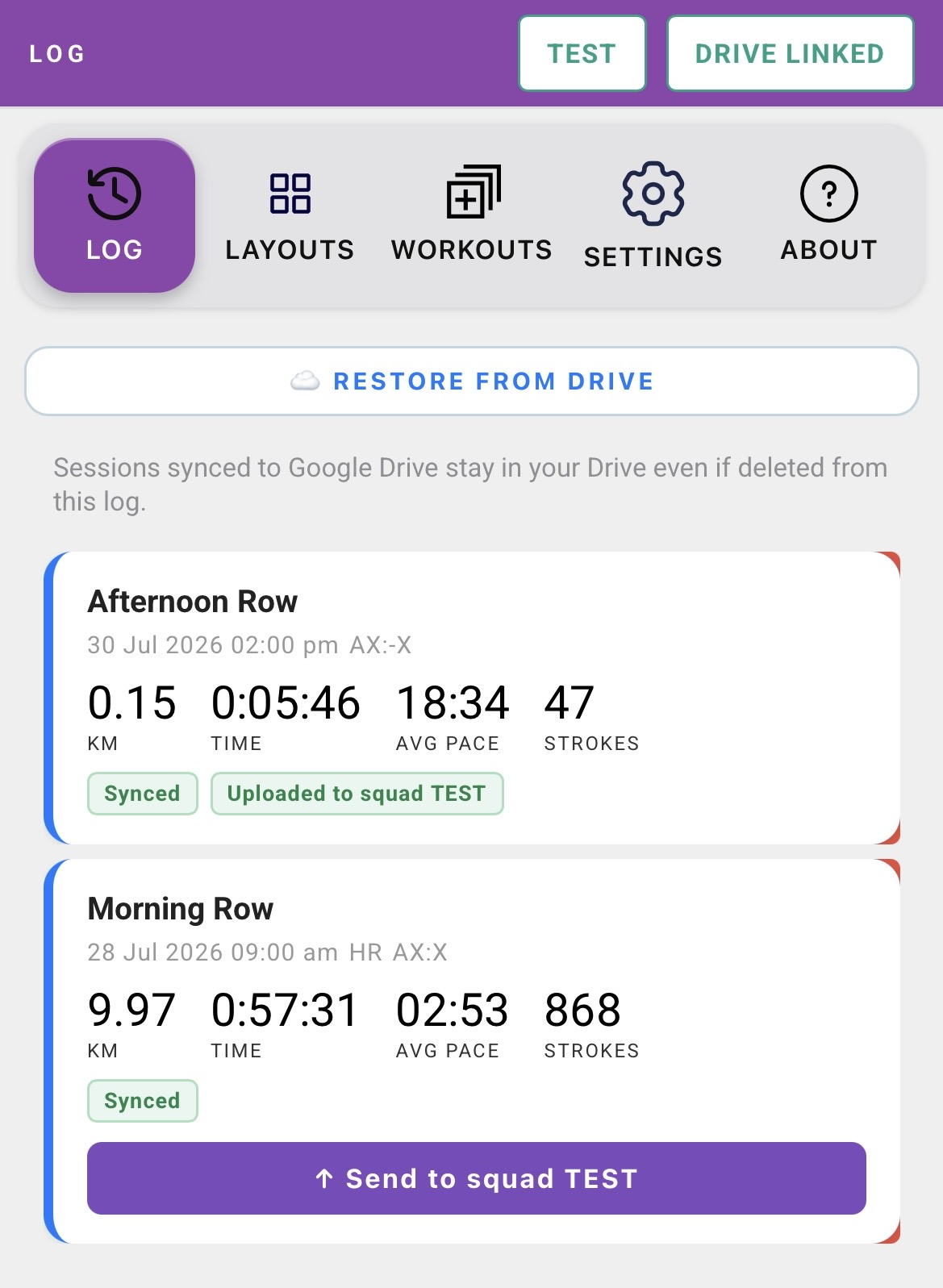
Deleting anywhere deletes everywhere. Swipe a card left in HOME → LOG and tap the red DELETE, or use the trash icon in the Analyser, and it goes from that device, from your Google Drive, and from every other device on its next sync.
Use this only when you genuinely want the session gone. To make room on the phone, use STORAGE… above instead - it frees the same space and keeps every session.
There is no undo. The file is removed from the hidden app folder in your Drive, which is not the same as Drive's normal bin - it cannot be recovered from there afterwards. Both apps therefore ask you to confirm first, and the phone names the session in the confirmation so a mis-swipe is caught before it does any damage.
If you delete while offline, the session goes from the phone immediately and the Drive copy is removed the next time you sync. The app tells you which of the two happened.
The DELETE MY DRIVE DATA button in SETTINGS – YOUR DATA wipes every session in your Drive at once, and is the only bulk delete.
Export anything you want to keep before deleting it. Raw data export is free forever - TCX, FIT, CSV and JSON - so a session you export is yours regardless of what happens to your Drive or your subscription.
7. Basic, Pro and Coach
Free trial
Every new install gets 30 days of full Pro, granted by the app. No card, no sign-up, nothing to cancel. The Settings → SUBSCRIPTION card counts down the days.
When it expires, you drop to Basic. Nothing is deleted and nothing is locked away - all your recorded sessions, all your exports, all your raw data stay fully accessible as long as you keep your Google Drive or your exported JSON files.
What Basic gives you
- Pace, Stroke Rate, DPS and Heart Rate tiles
- All the selectable-tile fields (time of day, elapsed, lap time, distances, average and lap pace)
- 20 minute recording limit per session - you get a warning with 2 minutes left, then the session finishes and saves itself
- Full session log, full Drive sync, full restore
- Every export - JSON, CSV, TCX and FIT - always free
- Analyser: single-session analysis, always free
- Viewer: always free, always full
Raw data is never held hostage. If you recorded it, you can export it.
What Pro adds
Pro lifts the recording cap and unlocks every stroke metric, the live stroke acceleration curve on the water and on the erg, ideal stroke template overlays on the water and on the erg, custom workouts on the water and on the erg, squad erg mode with the live race track, and automatic Strava sync.
On the same account it also unlocks the Analyser properly: multi-session comparison, the video overlay, opening a whole squad at once, and the full stroke template workflow - build one from your own strokes, edit it, export it to the phone, and draw it on the video overlay.
Pro lets you take part in a squad erg race or squad training event. Setting one up is a Coach job - see below.
What Coach adds
Coach is the add-on for anyone running a crew or a squad. Coach includes Pro, so you don't buy both. It adds:
- Create squad codes - generate a code, name the squad, share it by QR for rowers to scan
- Password-protected squad codes - keep your squad's live data to your squad
- Live squad map - every connected rower as a labelled dot, your own boat shown separately
- Rower tiles - name, big stroke rate, big pace, plus whichever secondary metrics you choose, in a grid you can scale and reorder
- FREE ROW / RACE switch - flip the lower half between individual tiles and a ranked squad race panel
- Rower detail on tap - full metrics, live stroke curve, mini route map and a lap button for that one rower
- REQUEST CURVE - pull any rower's live stroke curve on demand, 5-60 seconds, without draining their battery all session
- LAP - ALL BOATS - start an interval on every boat at the same instant
- Create and push workouts to the whole squad, on the water or on the erg
- Set up squad erg races - build the piece, arm every monitor, watch the n/n LOADED readiness count, then start everyone together with a synchronised count-in
- Live race leaderboard - every rower ranked with pace, rate and metres ahead or behind, on a simulated track
- Push a stroke template to the whole squad or one rower mid-session, and hide it again remotely
- In-app video - record a clip tagged to that rower and that moment, saved to a cloud folder and dropped straight onto their session in the Analyser
- Collate and export every rower's session from one place
- Coach from an erg - push and start a squad piece without leaving the coach screens; your own machine arms and starts with everyone else
Rowers do not need Coach. One Coach subscription on your phone covers the whole squad - they join free with the code.
The three levels side by side
| Basic | Pro | Coach | |
|---|---|---|---|
| Price | Free | Subscription | Subscription |
| Recording length | 20 min | Unlimited | Unlimited |
| Pace, Rate, DPS, HR | ✓ | ✓ | ✓ |
| Selectable tiles (time, elapsed, lap, distances, avg pace) | ✓ | ✓ | ✓ |
| Pos / Neg Catch Slope, Catch Accel, Catch Dur, Drive Time | - | ✓ | ✓ |
| Impulse, Drive Accel, Recovery Accel | - | ✓ | ✓ |
| Recovery Loss, Vel Efficiency | - | ✓ | ✓ |
| Stroke Char, Stroke Ratio | - | ✓ | ✓ |
| Live stroke curve, water and erg (CURVE tab) | - | ✓ | ✓ |
| Stroke template overlay on the live curve, water and erg | - | ✓ | ✓ |
| Custom workouts, water and erg - tile and interval countdown | - | ✓ | ✓ |
| Squad erg mode - join a race, live race track | - | ✓ | ✓ |
| Squad erg mode - set up races and training events | - | - | ✓ |
| Strava auto-sync | - | ✓ | ✓ |
| Analyser: single-session analysis | ✓ | ✓ | ✓ |
| Analyser: multi-session comparison, video overlay | - | ✓ | ✓ |
| Analyser: create, edit, load and view stroke templates | - | ✓ | ✓ |
| Analyser: open a whole squad at once | - | ✓ | ✓ |
| Analyser: stroke template on the video overlay | - | ✓ | ✓ |
| COACH role and COACH tab | demo only | demo only | ✓ |
| Live squad monitoring (all rowers, map + tiles) | - | - | ✓ |
| Rower detail on tap - curve, metrics, mini-map, per-rower lap | - | - | ✓ |
| REQUEST CURVE - pull a rower's live stroke curve on demand | - | - | ✓ |
| LAP - ALL BOATS simultaneous interval marker | - | - | ✓ |
| Create and push workouts to the whole squad | - | - | ✓ |
| Push a stroke template to the squad mid-session | - | - | ✓ |
| In-app video recording tagged to a rower | - | - | ✓ |
| Collate and export all squad sessions | - | - | ✓ |
| Create squad codes, share by QR | - | - | ✓ |
| Password-protected squad codes | - | - | ✓ |
| Join a squad with a code | ✓ | ✓ | ✓ |
| All exports (JSON / TCX / FIT / CSV) | ✓ | ✓ | ✓ |
| Drive sync and restore | ✓ | ✓ | ✓ |
| Viewer (spectators ashore) | ✓ | ✓ | ✓ |
One subscription covers the app and the Analyser on the same account. Monthly or yearly. Buy it from Settings → SUBSCRIPTION → UPGRADE TO PRO or UPGRADE TO COACH, or from the Account & Plan panel.
Locked tiles show PRO - Upgrade to unlock rather than disappearing, so you can see what you're missing.
8. Heart rate monitor
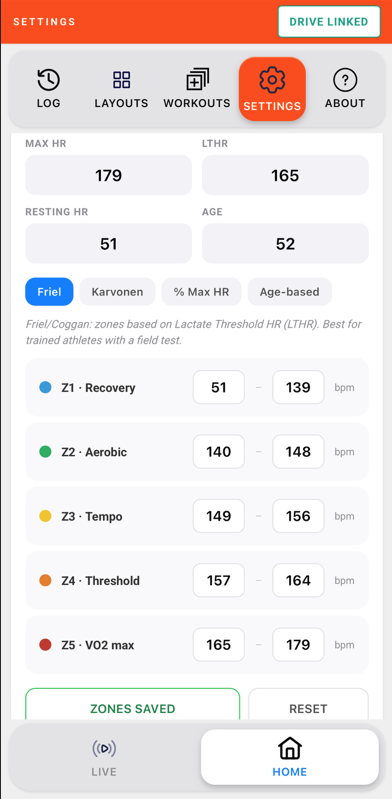
BoatRun connects directly to a Bluetooth heart rate strap - Polar H10, Garmin HRM, Wahoo, anything speaking standard BLE heart rate. Connect on the live screen prior to start, or in the settings menu.
Connect before you press Start. The app reconnects automatically on later sessions once it knows the strap, but the first pairing should happen on dry land.
HR appears as its own tile with a zone bar, is recorded into the session, exports in TCX and FIT, and charts in both the session detail and the Analyser.
Zones are configurable - the app supports Friel/Coggan LTHR zones, percentage of max HR, and age-predicted. The zones are synced via your Google Drive and are available in the header of the Analyser website during workout review.
9. Recording a session
The LIVE tab
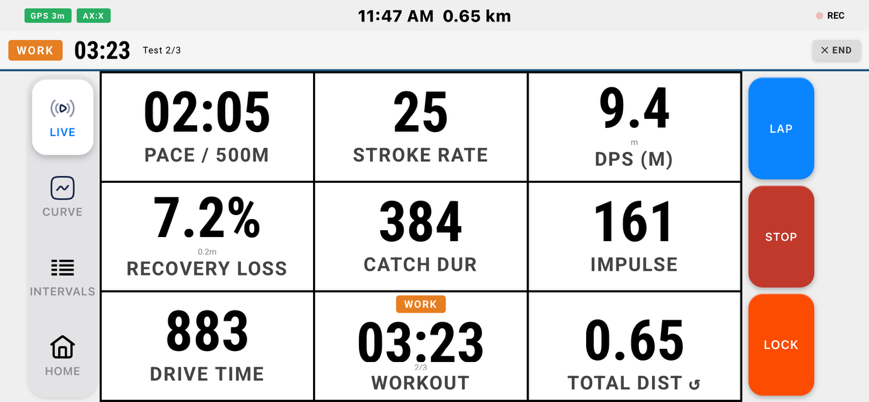
Your main display of user selectable metrics. The layouts menu defines the variables displayed here.
The CURVE tab (Pro)
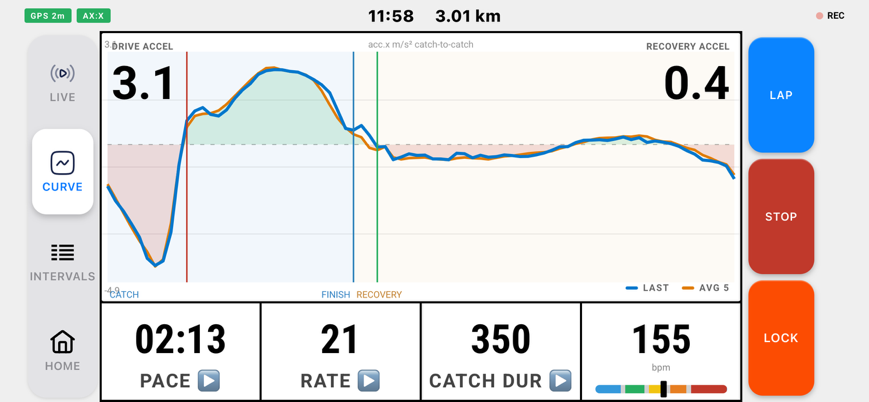
The acceleration curve for one full stroke, catch to catch. Last stroke in blue, 5-stroke rolling average in orange. Green fill above zero acceleration, red below zero acceleration.
Three figures sit on the curve itself, each a 5-stroke rolling median:
- Drive Accel, top left - the highest point of the curve, peak acceleration during the drive
- Recovery Accel, top right - peak acceleration during the recovery
- Catch Accel, a third of the way in from the left, bottom of the curve - the lowest point of the curve, peak deceleration at the catch. This one reads as a negative number
Four tiles underneath. Tap on each one to bring up a selection of available metrics.
Stroke templates on the live curve (Pro)
Who can do what with templates: Pro covers the lot - building and editing a template in the Analyser, exporting it, importing it onto the phone, arming it on your live curve, and drawing it on the video overlay. The only template job that needs Coach is pushing one out to a squad mid-session.
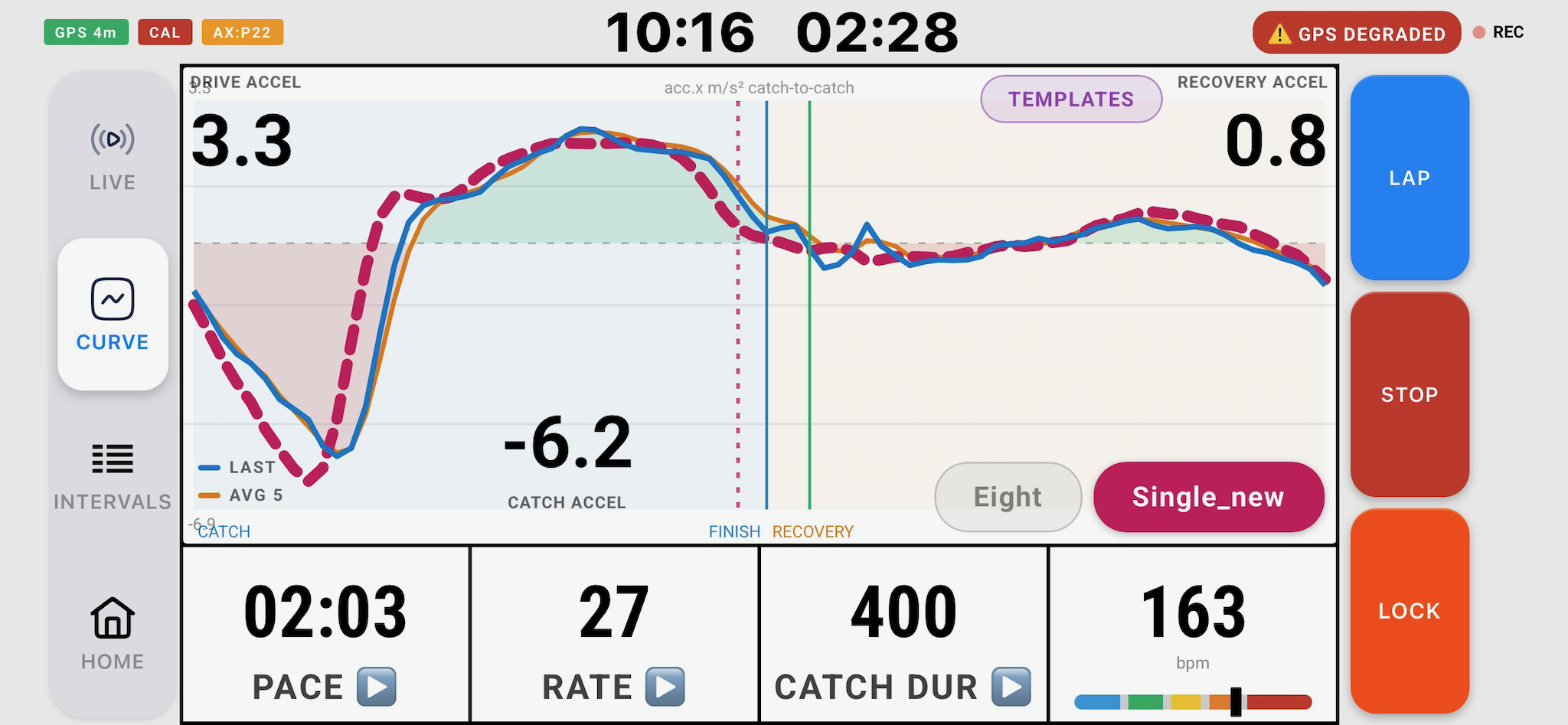
A template is a target stroke shape built in the Analyser - see section 15 for how to make one. On the phone it is drawn as a dashed line behind your live curve, continuously re-timed to whatever rate you are actually rowing, so you are always comparing like with like.
Getting templates onto the phone
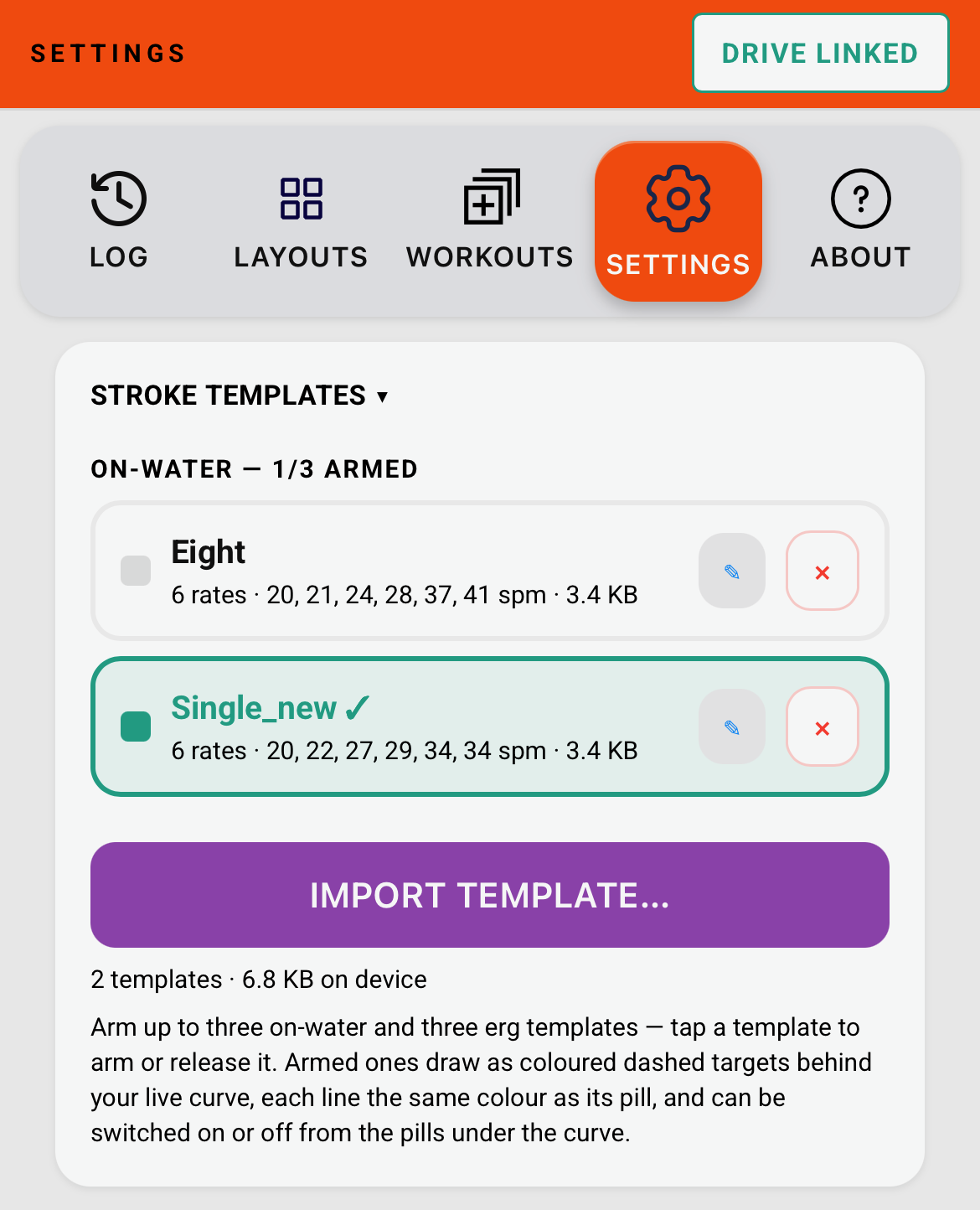
HOME → SETTINGS → STROKE TEMPLATES → IMPORT TEMPLATE…. Pick the JSON file the Analyser exported. Re-importing a file you already have replaces it rather than making a duplicate.
The list underneath is split into ON-WATER and ERG, each headed with how many are armed - 2/3 ARMED, for instance. Each row shows a colour chip, the name, and how many rates it holds, their range, and its size. Rename with ✎, delete with ×. The running total sits at the bottom and turns orange once the library gets large. Templates live on the phone only - they are not synced.
Arming and showing them
You get three on-water slots and three erg slots, kept separately - arming three on-water templates never crowds out your erg ones. Arm a template either by tapping its row in that Settings list, or by tapping the TEMPLATES button at the top of the curve and picking from there. Both lists are the same set of slots.
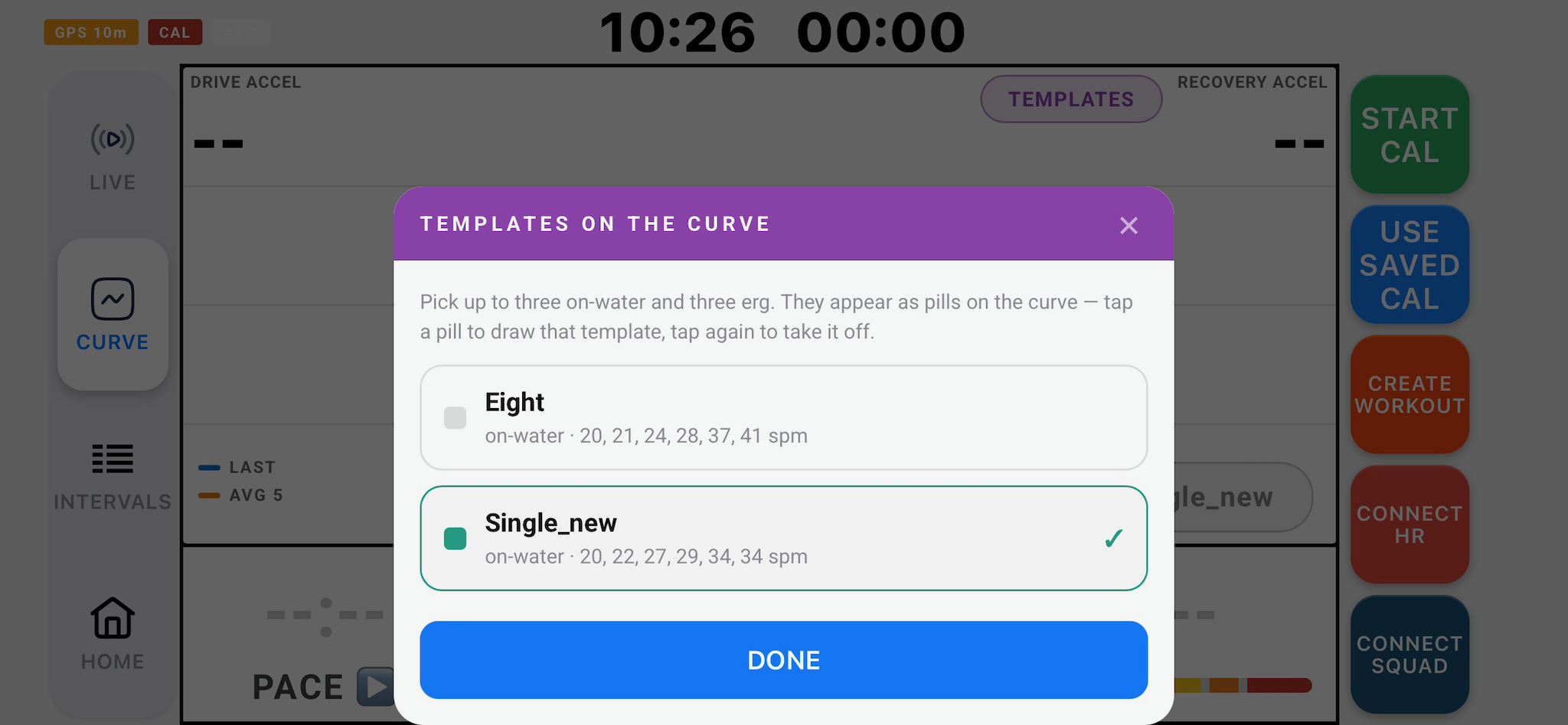
Each armed template gets a coloured pill in the corner of the curve, and its dashed line is drawn in the same colour as its pill. Tap a pill to draw that template, tap it again to take it off. This works without leaving the live screen, so you can switch targets mid-piece.
Only the matching kind is ever shown: on-water templates on the Row and Cox curve, erg force templates on the Erg curve. The other set stays armed, waiting for the mode it belongs to.
Reading it
Between the rates in the template the shape is interpolated. Above the highest rate it holds, the drive keeps its recorded length and only the recovery is compressed to fit - so a template built at 18-30 still gives you something sensible at 34.
Templates from your coach
If you are connected to a squad, your coach can push a template to your phone. It arrives as a fourth pill labelled COACH in purple. Tap it off if you do not want it on screen - your coach sees that you have hidden it. The coach can also hide it remotely.
Templates are boat-class specific. A single scull template means nothing in a quad or an eight.
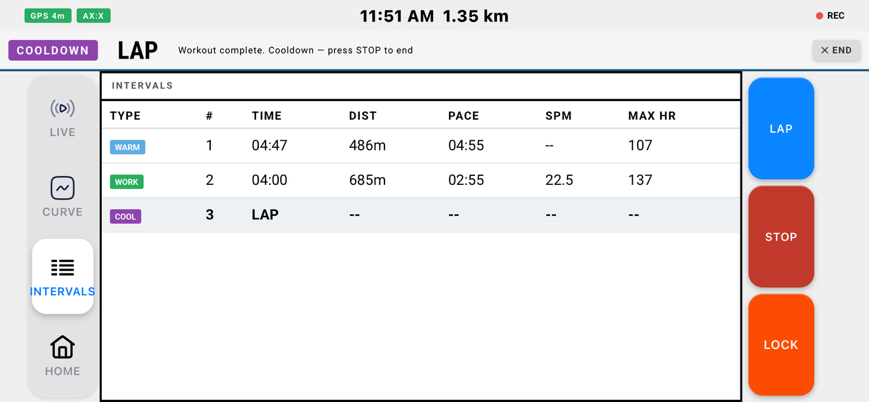
The INTERVALS tab
Shows the step sequence and per-interval metrics as you complete them.
Starting - when the clock actually begins
Pressing START puts the app in a ready state rather than starting the clock. The boat is usually still tied up, or being backed down, and none of that should land in your session - so distance, pace and elapsed time all stay at zero until the boat is genuinely under way.
Three things can release it, whichever happens first:
- You move. About 20 metres from where you pressed START. This one needs nothing from the accelerometer, so it works even on the lightest warmup paddle.
- You pick up speed. Two GPS readings above walking pace.
- You take two strokes. The quickest path, and the only one that backdates the clock by a couple of seconds so the very first stroke belongs to the session.
Earlier versions waited on stroke detection alone. If your warmup catches were very light the app could sit in the ready state for several minutes, only starting when you rowed harder. Movement now releases it regardless, so a gentle paddle away from the pontoon starts the session within about ten seconds.
Laps
Tap LAP to mark a split. Each lap records time, distance, pace, rate and HR.
The lap button changes colour
| Blue - LAP | Normal split, or advance to the next workout step. Takes effect the instant you press it. |
| Light blue - LAP READY | Pressing will split and arm ready mode instead of just splitting. The button offers this whenever the boat is sitting still (no workout loaded), or when the next workout step is a row-when-ready step. |
| Light green - READY | Ready mode is armed. The lap clock is held and waiting for you to start rowing. |
Ready mode
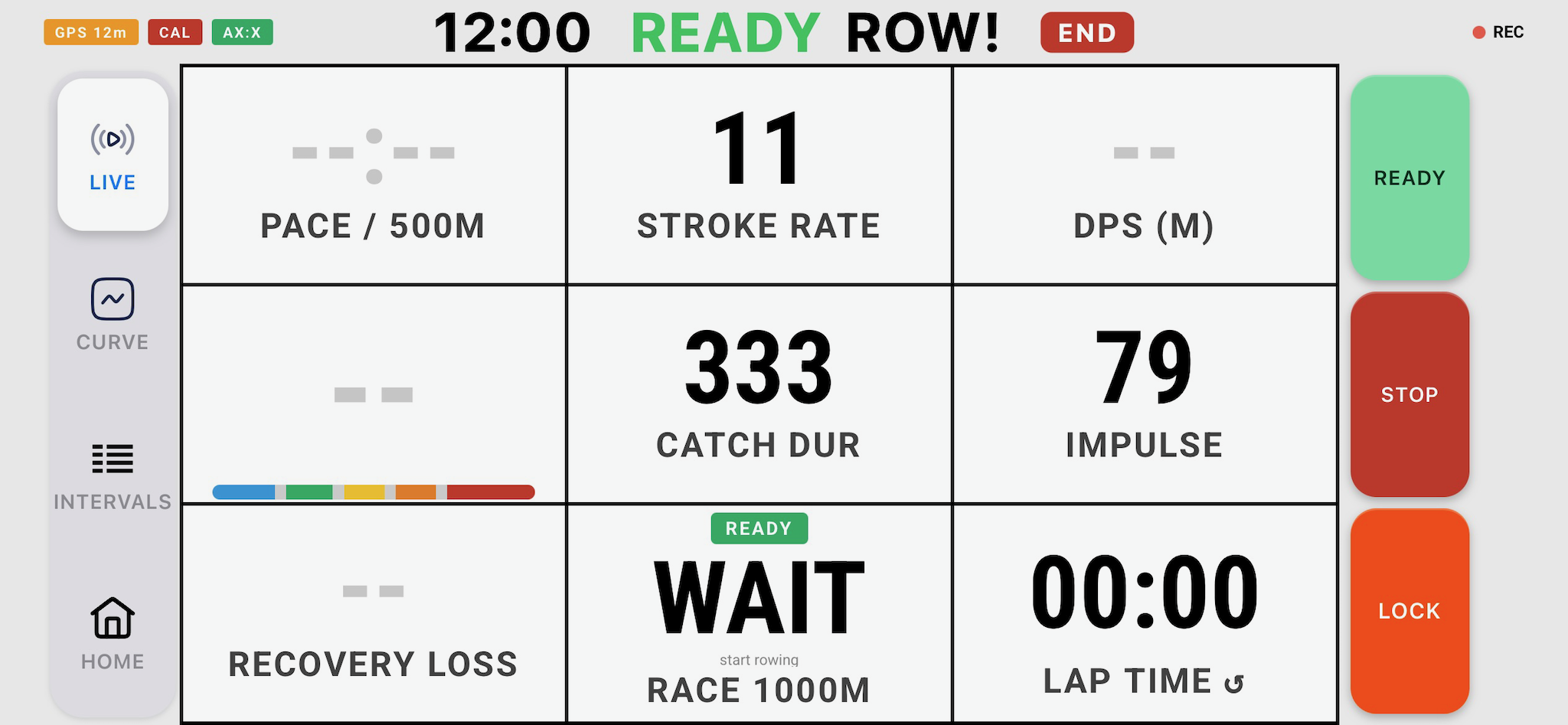
Press the light blue LAP READY button while sitting at the start. The previous lap closes there and then, and the new lap does not begin. Sit as long as you like, back the boat down, line up on the buoy - none of that stationary time lands in your work piece.
The new lap starts on its own after two strokes at a real rate. It backdates itself by about 2 seconds so the very first stroke of the piece belongs to the piece, not to the sitting-around before it. A single bump - the boat rocking, catching the pontoon, shifting on the seat - will not trigger it; the first 2 seconds after arming are ignored entirely, and if the rate is very low it waits for four strokes rather than two.
If you would rather not wait for the detection, press the green READY button and the lap starts immediately. It then goes straight back to light blue, because the boat is still stationary and ready mode is on offer again.
With a workout loaded
Timed and distance steps advance on their own - work for 1000m, rest for 4 minutes. Open-ended steps do not, so press LAP to end a warmup or an open rest period.
How the first work step begins is one choice made on the workout itself, not on the step - see section 11. Set to AFTER 5 SEC, pressing LAP at the end of the warmup runs a 5-4-3-2-1 countdown into the piece. Set to WHEN ROWING, the button shows LAP READY and the same two-stroke gate applies: the step waits, the workout bar reads READY / ROW!, and the countdown only begins once you are actually rowing. Press the green READY button to force it to start.
Everything after that first step runs straight through without waiting.
Stopping and finishing
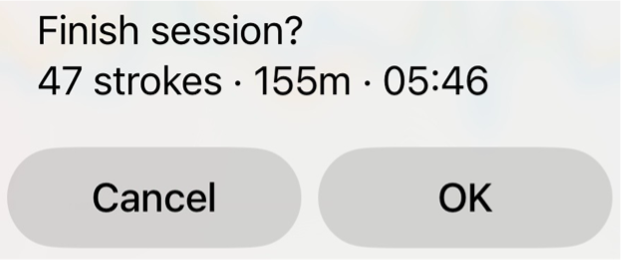
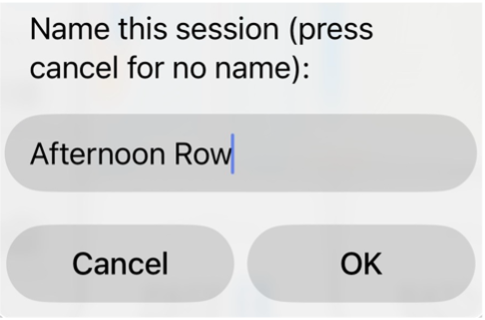
STOP pauses, RESUME continues, FINISH ends and saves.
The app autosaves at least every 2 minutes. If it closes mid-session (battery, crash, anything) the recording is recovered next time you open the app.
10. Layouts and tiles
HOME → LAYOUTS
A layout profile stores a grid size and a metric per slot, held separately for portrait and landscape for each grid size. Rotate the phone and the layout swaps automatically.
Built in
| Profile | Portrait | Landscape |
|---|---|---|
| Race | 2×3 - pace, rate, catch dur, HR, workout, selectable | 2×2 - pace, rate, catch dur, workout |
| Training | 2×4 - pace, rate, DPS, catch dur, impulse, HR, workout, selectable | 3×3 - pace, rate, DPS, HR, catch dur, impulse, recovery loss, workout, selectable |
Tap a profile name to make it active. + NEW PROFILE to build your own - choose a grid for each orientation, then tap each slot to assign a metric.
Grid options - landscape: 3×3, 3×2, 2×2, 2×1, 1. Portrait: 2×4, 2×3, 2×2, 1×2, 1.
Assignable metrics
| Tile | Tier |
|---|---|
| Pace | Basic |
| Stroke Rate | Basic |
| Dist / Stroke | Basic |
| Heart Rate | Basic |
| Selectable | Basic |
| Negative Catch Slope | Pro |
| Catch Accel | Pro |
| Positive Catch Slope | Pro |
| Catch Dur | Pro |
| Drive Time | Pro |
| Impulse | Pro |
| Drive Accel | Pro |
| Recovery Accel | Pro |
| Recovery Loss | Pro |
| Vel Efficiency | Pro |
| Stroke Char | Pro |
| Stroke Ratio | Pro |
| Workout | Pro |
| - (blank) | - |
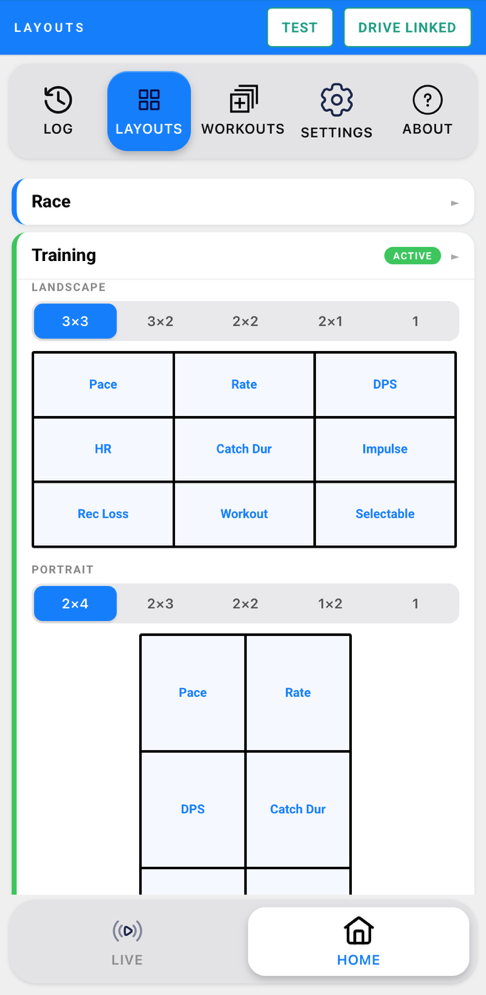
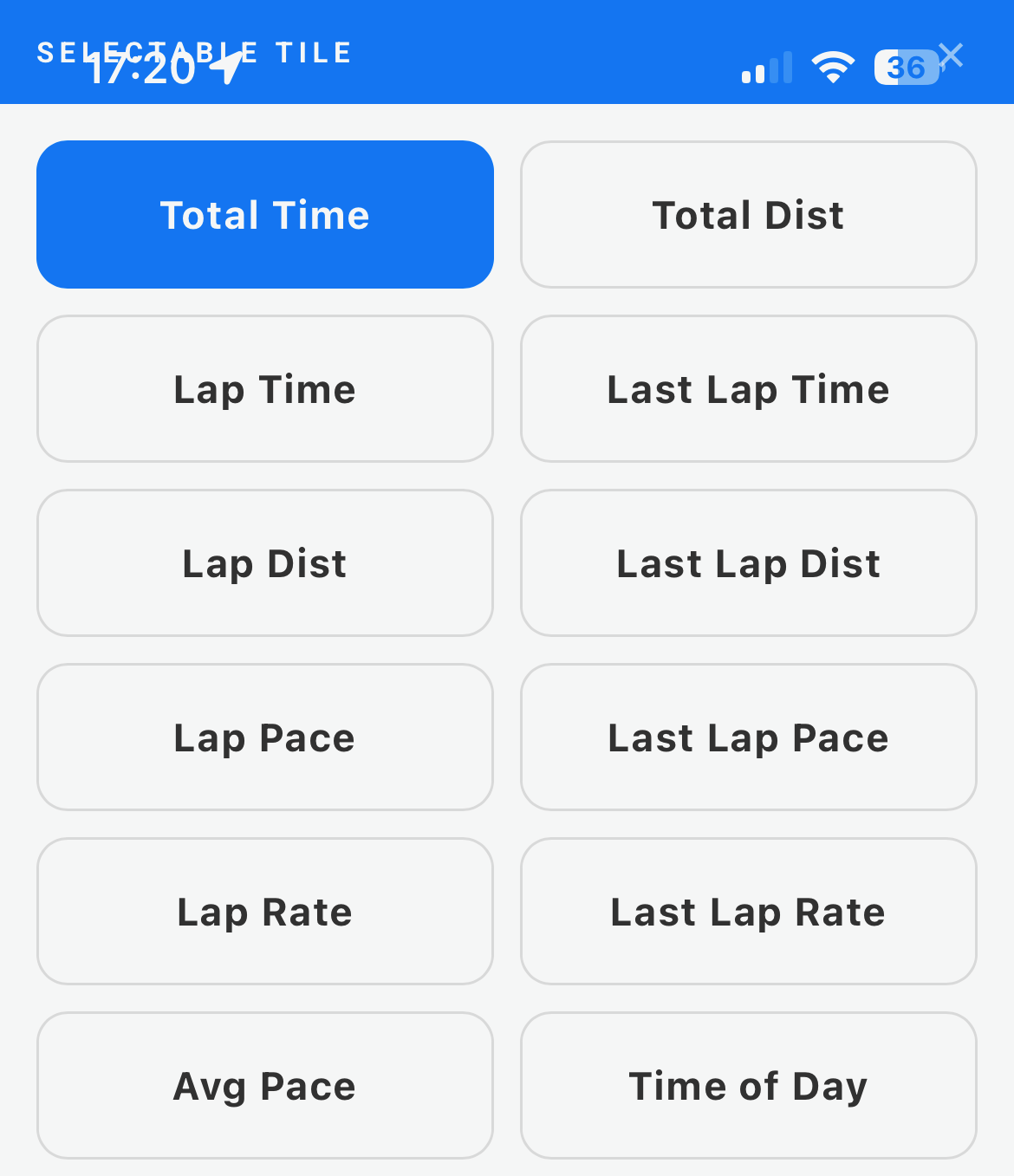
Tapping on a SELECTABLE TILE brings up a sub-menu of available options. Each slot remembers its own setting between sessions.
11. Workouts
HOME → WORKOUTS
On-water and erg are two separate sets
Every workout belongs to one venue or the other, and you only ever see the set that matches what you're doing - on-water workouts in Row and Cox, erg workouts in Erg mode. Erg ones carry a red ERG badge. Coach mode sees both and switches between them with the ON WATER / ERG buttons at the top of the list, because a coach sends to both halves of a squad.
A new workout is created in whichever set is on screen at the time.
Built in
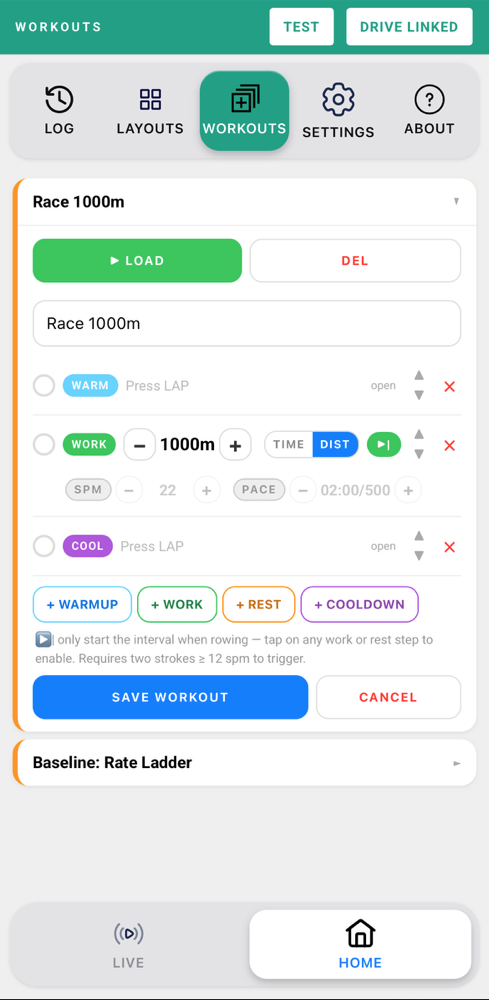
Race 1000m - open warmup until LAP pressed → 1000m work → open cooldown until you press STOP.
Baseline: Rate Ladder - open warmup → 4 × [1 min 24, 1 min 26, 1 min 28, 1 min 30, 4 min rest] → open cooldown. The last rest is skipped.
Erg: 6 × 500m / 3min - the erg-set default, pushed straight to the PM5.
Building your own
+ NEW WORKOUT → name it → add steps with the coloured buttons underneath.
An on-water workout always opens with a WARMUP and always ends with a COOLDOWN. They are fixed bookends - no tick box, no delete, no arrows - so nothing can be dragged outside them. Erg workouts have neither, because the PM5 has no equivalent and there is no lap button on the erg to end an open-ended step with.
| Step | What you set |
|---|---|
| WARMUP | Nothing. Runs until you press LAP. |
| WORK | TIME or DIST, then the value. Optional targets underneath - tap SPM and/or PACE to switch each one on, then set it with the − and + buttons. |
| REST | TIME, DIST, or LAP for an open rest that only ends when you press LAP. |
| COOLDOWN | Nothing. Runs until you press STOP to finish the session. |
Every value can be nudged with the big − and + buttons or typed straight into the box - m:ss for times, plain metres for distances. The ▲▼ arrows beside a step move it up or down the list; × deletes it.
Start - one choice for the whole workout
Directly under the warmup is a single Start: row. This replaces the old per-step ready-mode toggle, which is gone.
| AFTER 5 SEC (blue) | Press LAP at the end of the warmup and a 5-4-3-2-1 countdown starts the first work step. |
| WHEN ROWING (green) | Ready mode. The lap button offers LAP READY during the warmup, then sits on green READY and the first work step waits until you are actually rowing. |
The two buttons are coloured to match the LAP button you will be pressing, so you are picking the button, not a setting. After the first work step the piece runs straight through on its own.
Repeats
Tick two or more adjacent steps and the ↻ REPEATS button appears. Tap it, give it a count, and they become a repeat block. Set the count in the box on the block header, and tick Skip last rest if you don't want the final rest to run. Skip-last-rest is on-water only - the PM5 always counts down every rest it was armed with, including the last.
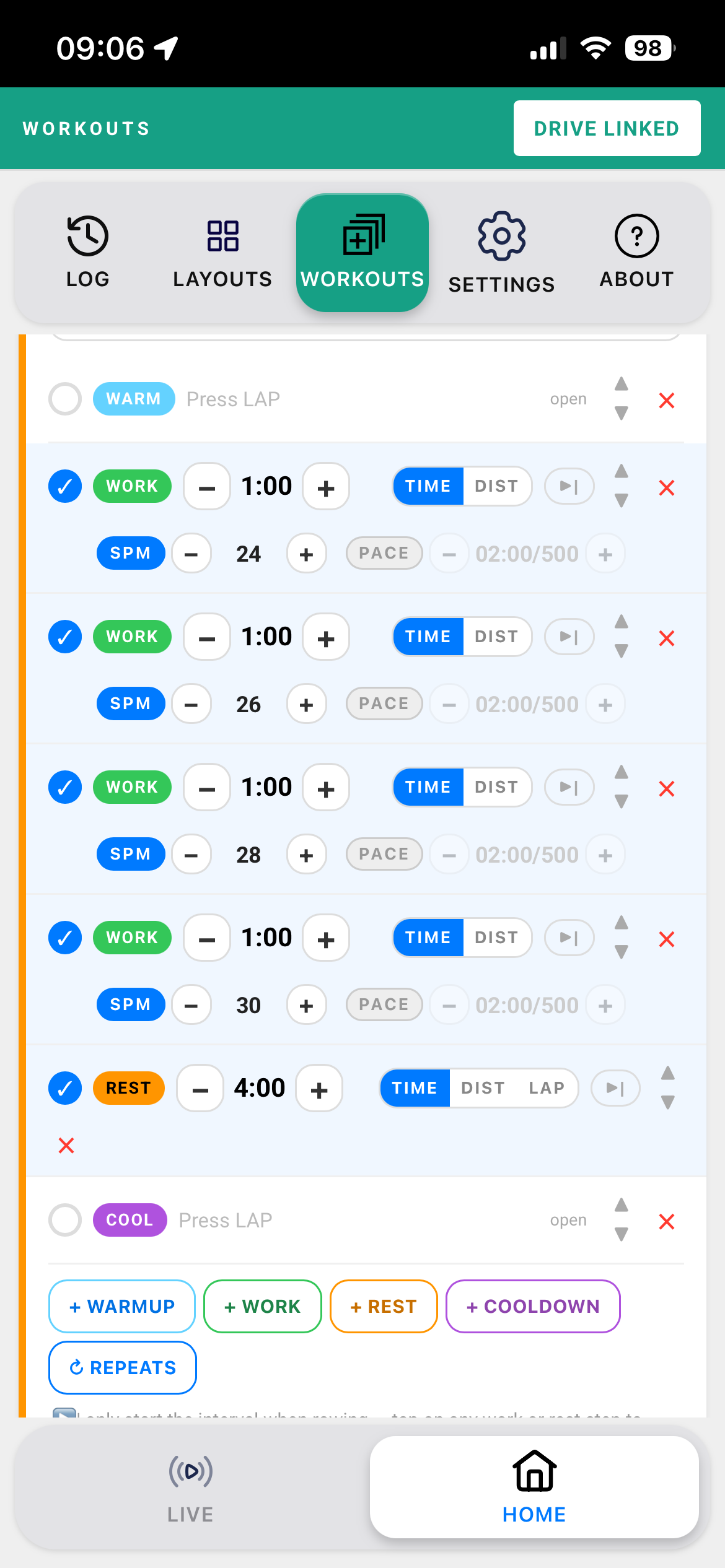
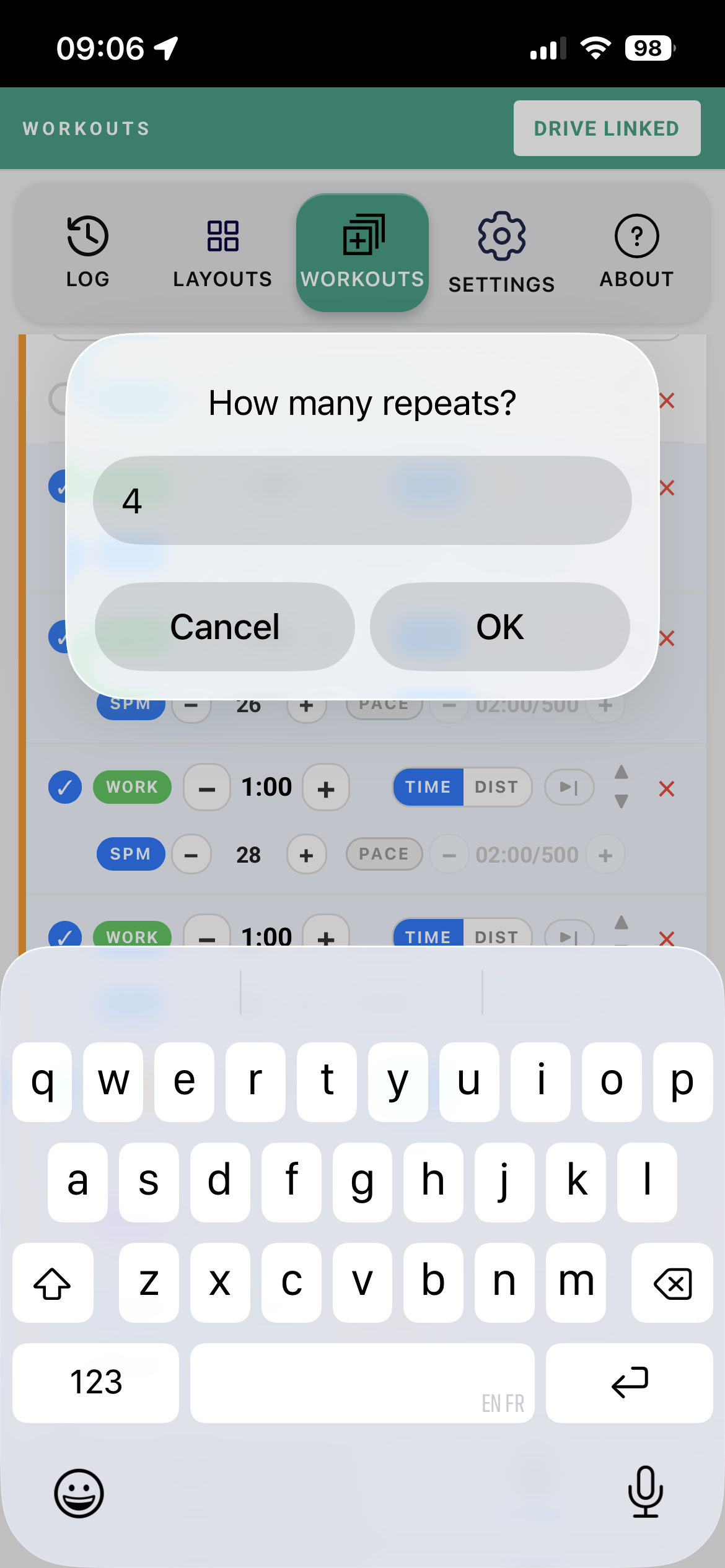
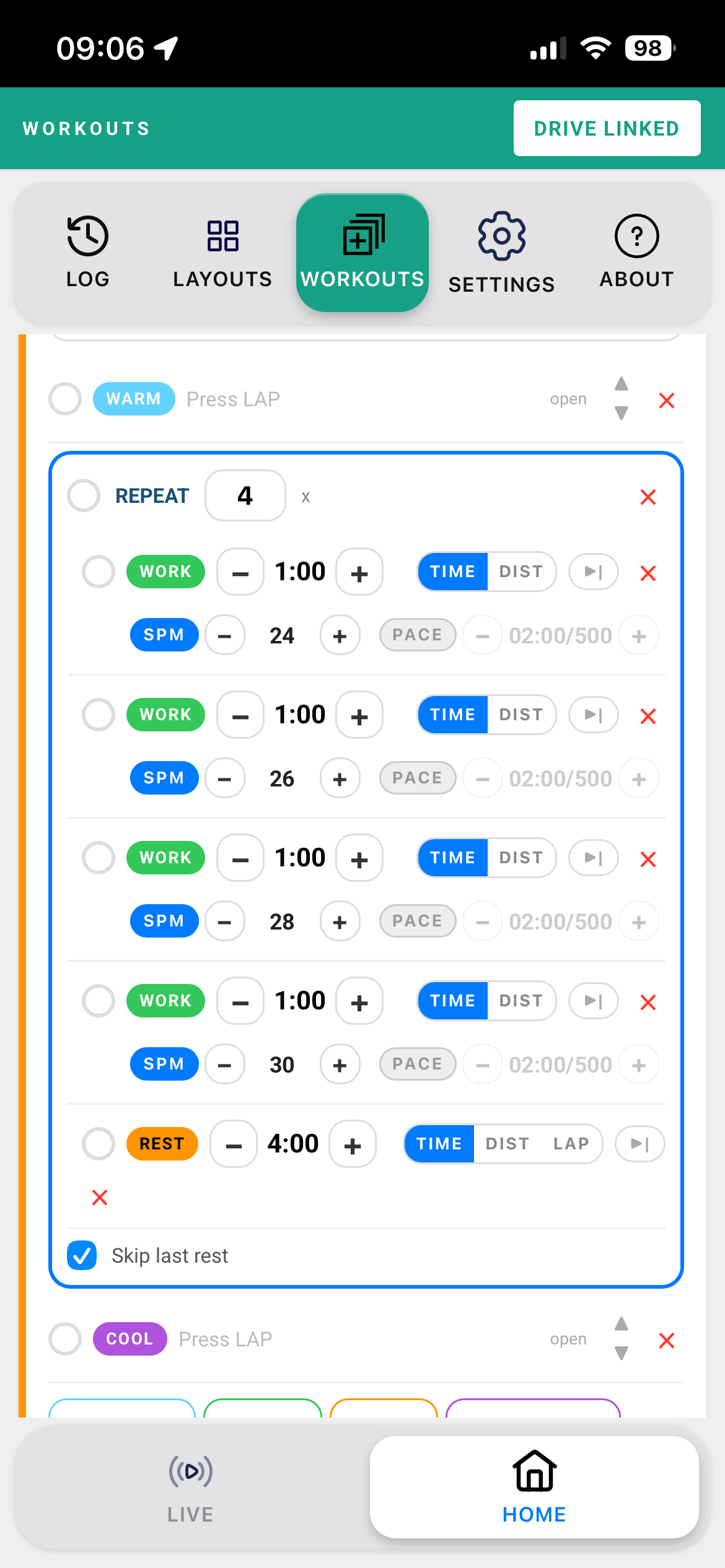
SAVE keeps it in the list; CANCEL drops it. Tapping a workout card opens it - EDIT reopens the builder, DEL removes it.
Building one mid-session
You don't have to go back to HOME. The Load Workout button on the live screen opens a quick builder: a straight distance, a straight time, a set of identical intervals with rest, or a list of different intervals. Give it a name to save it to your library, or leave the name blank to just run it once. On the water it gets the same START choice, and warmup and cooldown are added around it automatically.
The same screen lists your saved workouts, so this is also the quickest way to load one you already have. In Coach mode the button reads SEND TO SQUAD instead.
During the workout
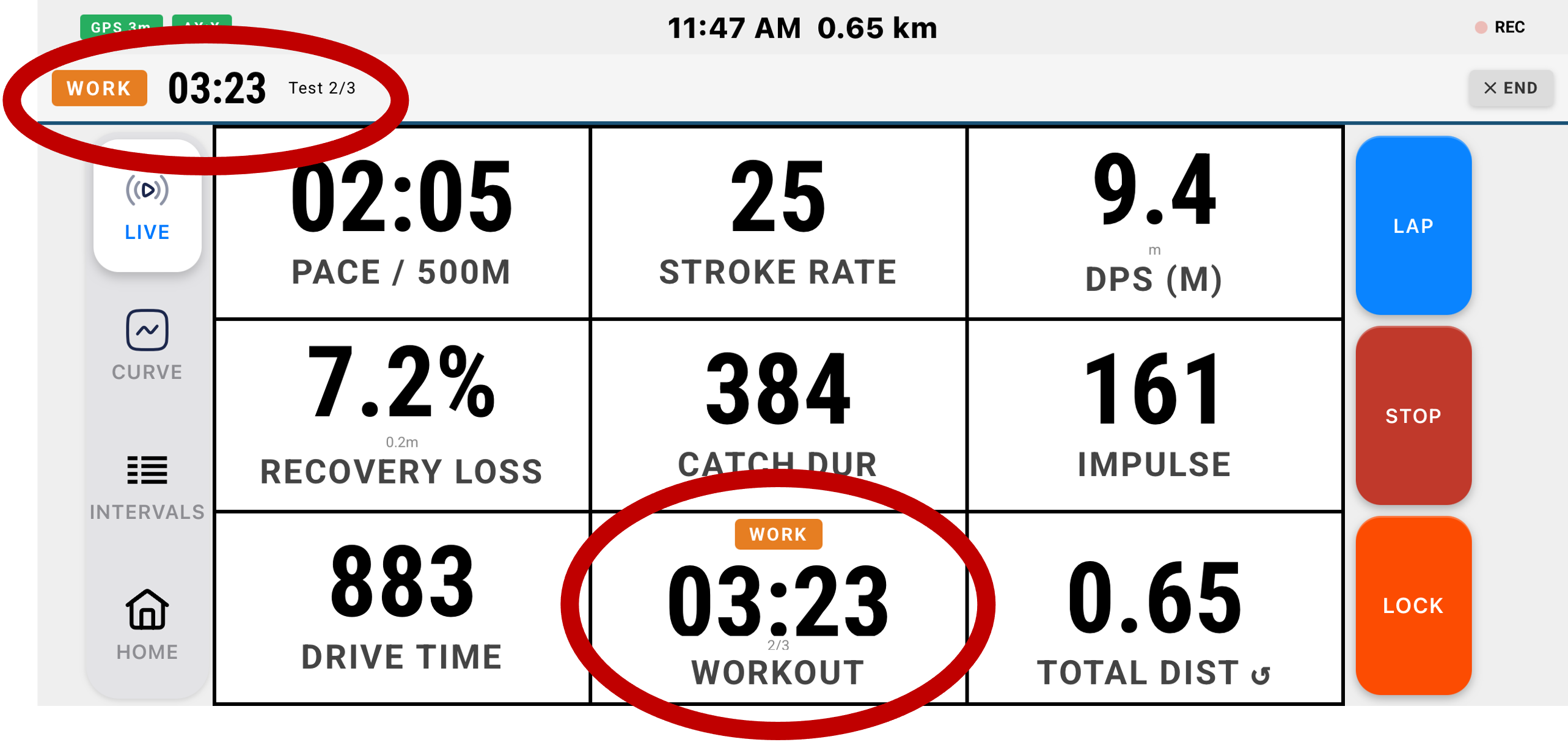
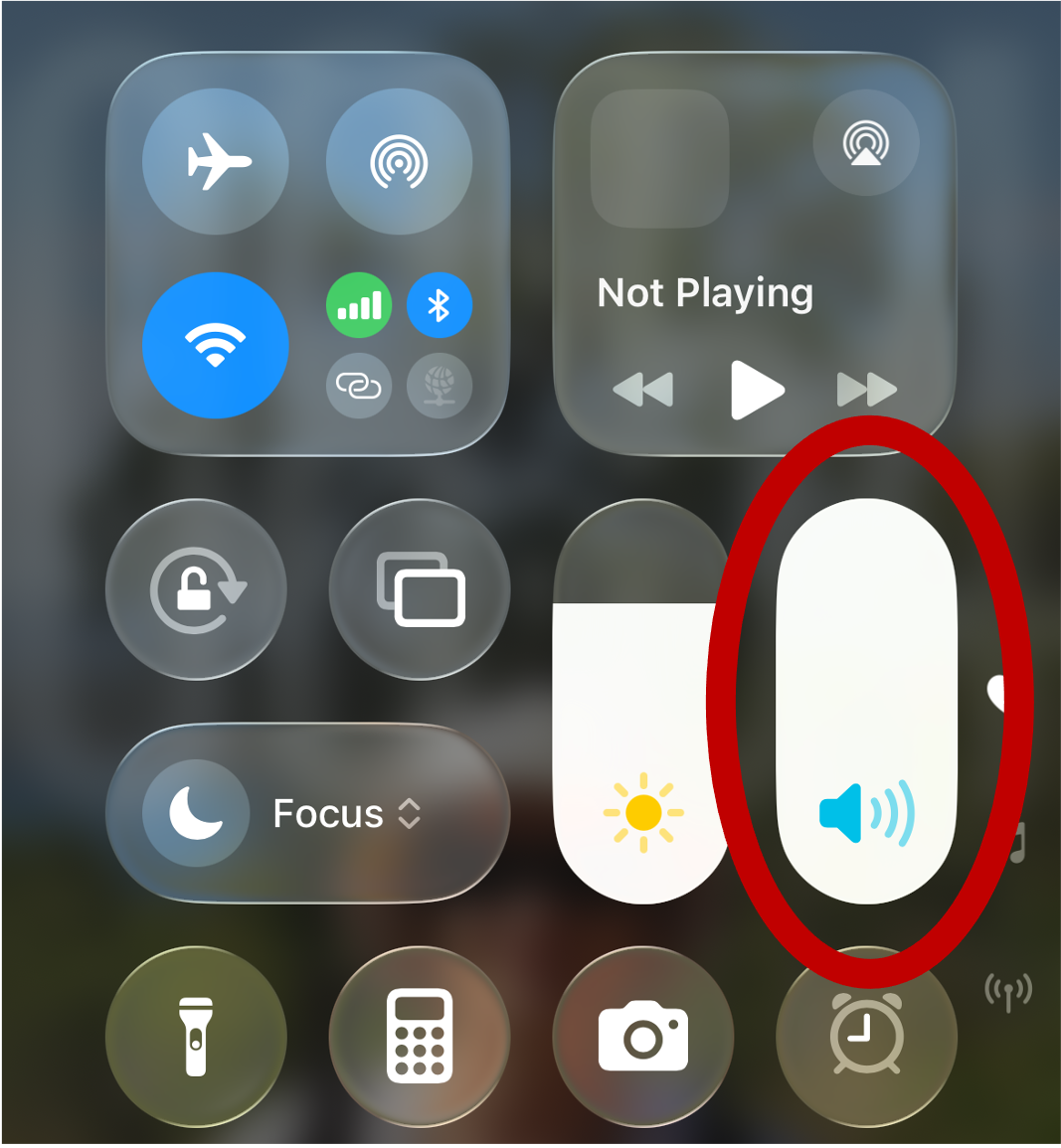
The INTERVALS tab counts down. The workout tile shows the current step and time or distance remaining. The step is also displayed in the top left corner of the display and on the coach's app (if connected). A 5-second countdown overlay appears before each work interval along with a tone (ensure the phone volume in control centre is at maximum and the phone is not on silent). At the end of the work interval, a tone will sound and a lap summary will appear.
Each interval is saved in the interval tab and exported for later analysis.
12. Connect to coach
Connect to a squad
HOME → SETTINGS → COACH'S SQUAD CODE
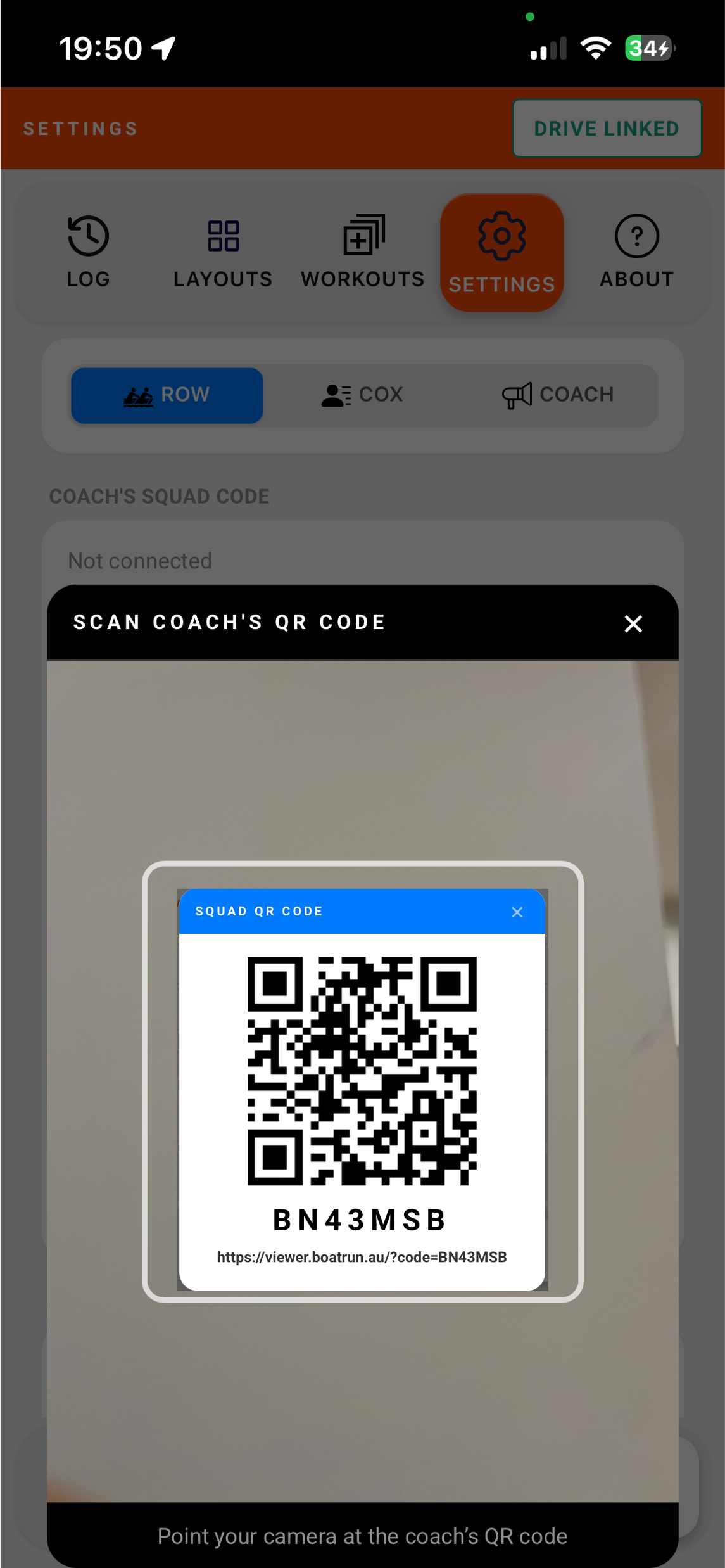
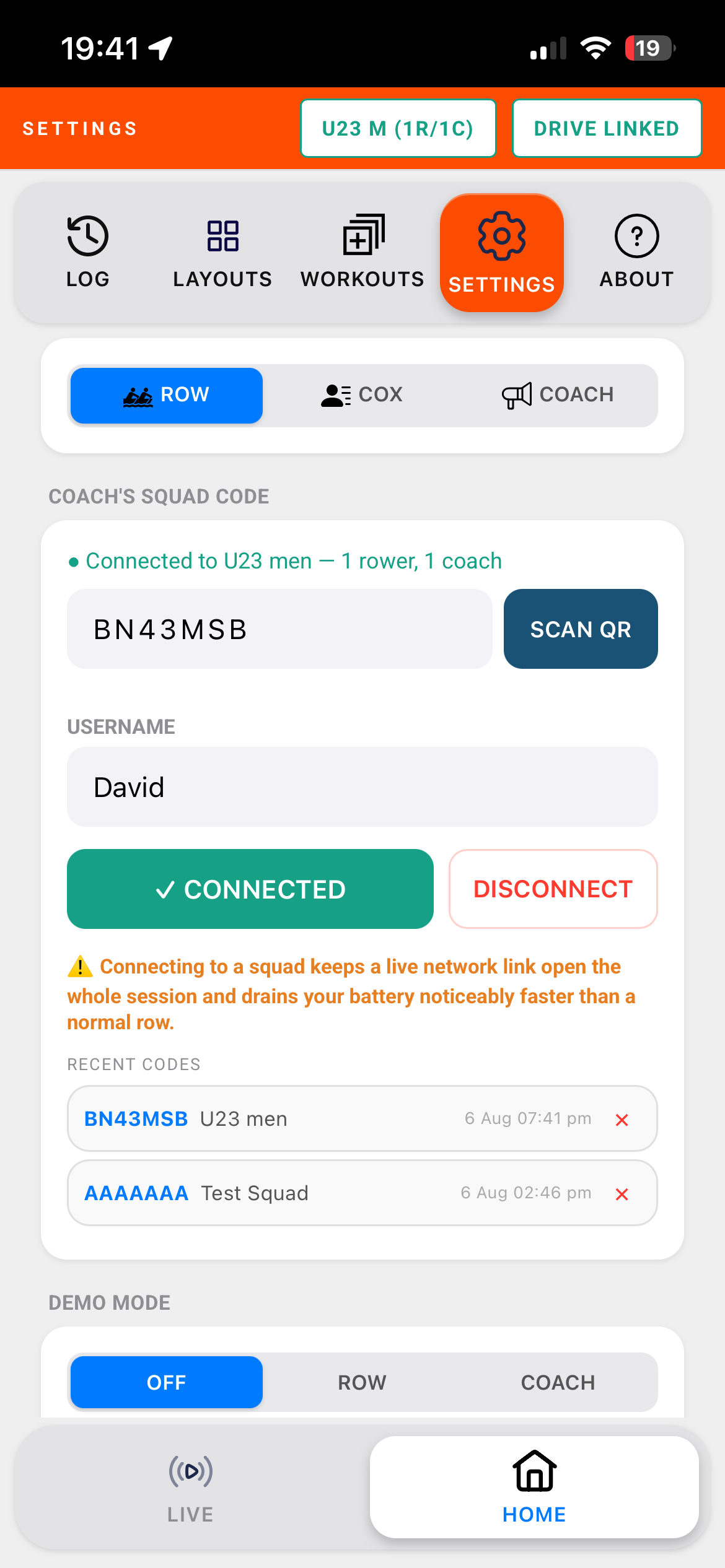
- Enter the code given by your coach (tap on the list below for previously used codes) or SCAN QR from coach
- Enter your name
- CONNECT
The coach will be able to see your location and name straight away. They will not be able to see your data until you press start. Advanced metrics and stroke curve will only be seen by your coach if you're a PRO user.
Your coach will be able to send you workouts and press lap for you. This is ideal for squads where everyone starts the interval at the same time.
Note: Coach mode keeps a live network open so drains your battery noticeably faster than a normal row, especially when the coach is viewing your stroke curve a lot. Having no one watching you via coach mode or the viewer application (no listener) uses negligible extra battery. It also means that in areas without reliable phone reception, coach mode may not be available. For example, Lake Barrington.
13. Coach mode
Set role to COACH at launch or in Settings.
Coach mode needs the Coach add-on. Without it, tapping COACH on the splash or in Settings opens the Coach paywall instead. The one exception is the COACH demo, which runs on canned data so you can see the whole thing before you buy. Rowers do not need Coach - joining a squad is free.
Setting up a squad
HOME → SETTINGS → CREATE A NEW SQUAD
- Enter squad name (only the first 5 characters are displayed on the rower's phone)
- Tap GENERATE for a new 7 character random code
- CREATE SQUAD
- Give the code to your rowers, or SHOW QR CODE for them to scan
- SHOW QR also lets spectators open the Viewer (take a screenshot and send it)
Generate a new code each session, or at least each term. Anyone with the code sees the squad's live positions and can download squad synced sessions through the Analyser website.
The COACH tab
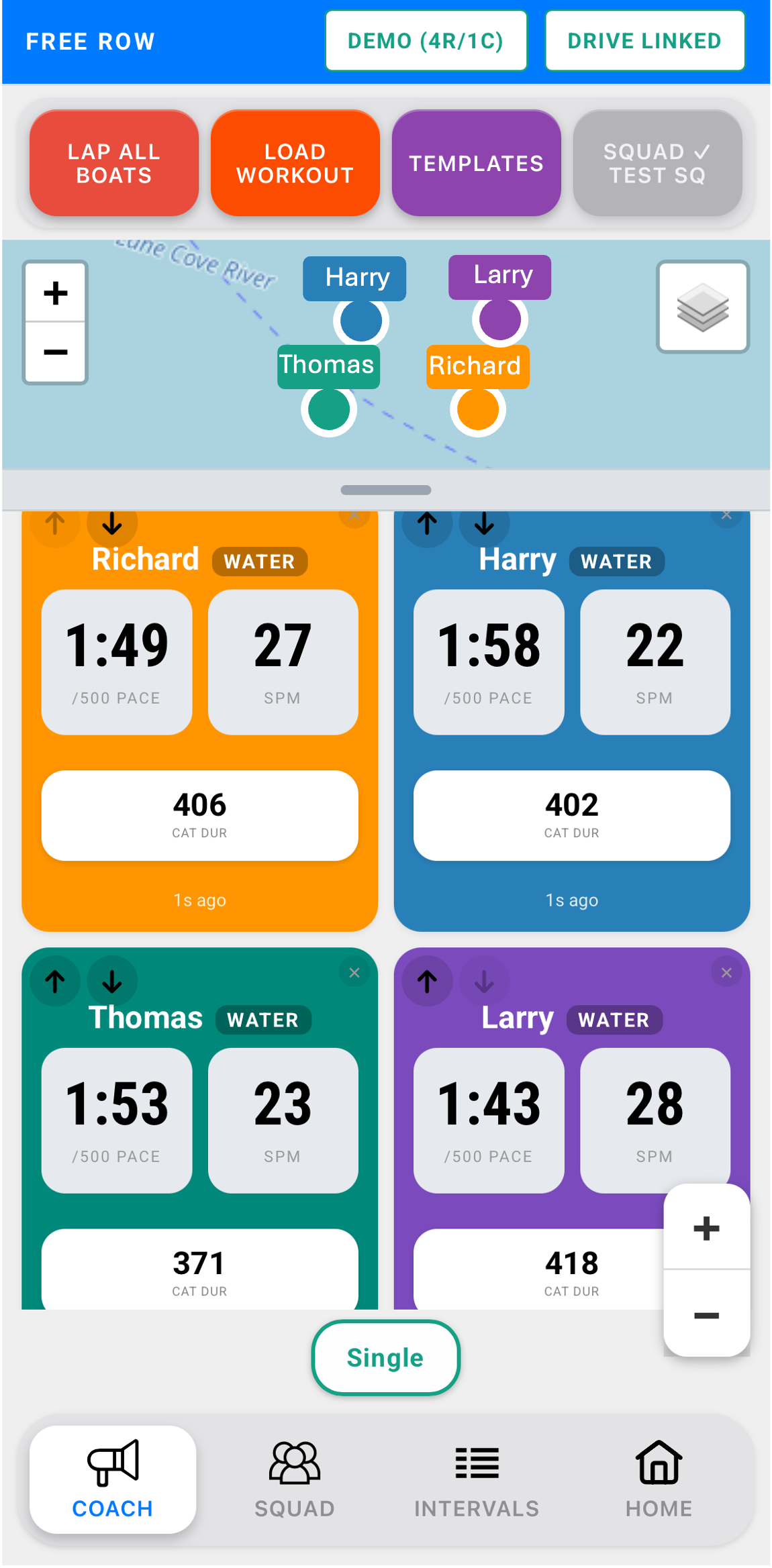
Squad map - every connected rower as a labelled dot, with your own position shown separately. Tap a dot or the individual's tile to open that rower's detailed view.
Rower tiles - one per rower: name, big stroke rate, big pace, plus whichever secondary metrics you've enabled in layouts. Use the + / − buttons to scale the grid. Use the arrow buttons in the top left of each tile to swap the order.
LAP - ALL BOATS sends a simultaneous lap to every connected rower. This is useful for starting an interval for everyone at the same time.
What each boat's colour means
One press of LAP ALL BOATS does three different things depending on what a boat is doing: it starts a boat that is sitting in ready mode, splits a boat that is rowing, and does nothing at all to a boat that is stopped or paused. So each tile is coloured by its state, and the whole tile changes - not just a small badge - so it reads at arm's length in sunlight.
| Their own colour - ROWING | Under way. A lap splits them. |
| Light orange - REST | Sitting in a rest interval of a workout. |
| Light blue - LAP READY | Waiting at the start with ready mode armed. A lap starts them rather than splitting them. |
| Light green - LAPPED · READY | Your lap landed and put them into ready mode. Stays light green for as long as they sit there, so you can see at a glance who is set and waiting. |
| Green - LAPPED | Your lap landed while they were rowing. Holds for 5 seconds, then back to their own colour. |
| Grey - STOPPED | Paused, finished, or pressed START but not moving yet. A lap does nothing to them. |
| Grey - NO SIGNAL | Nothing heard for 25 seconds. They may not receive the lap at all - usually a coverage blackspot. |
The green and light-green states are your confirmation that the command actually arrived on each phone, not just that you sent it.
Boat colours on the race track do not change - a lane has to stay trackable for the whole piece. Only the tiles and the name pills carry the state.
The LAP ALL BOATS button
The button takes the colour and the wording of whatever most of the squad is doing, with a count:
| LAP 4/4 | Blue. Everyone rowing and reporting in. |
| LAP · REST 4/4 | Light orange. Squad sitting in a rest interval. |
| LAP READY 3/4 | Light blue. Three boats sitting at the start armed and waiting. |
| LAPPED · READY 4/4 | Light green. Your lap landed on all four and they are set for the start. |
| STOPPED 3/4 | Grey. Most of the squad is not rowing. |
The second number is your boat total. Any first number below it is the thing to look at - it means somebody is in a different state to everybody else, or has dropped off.
If the squad is split across states, or anyone has gone quiet, tapping the button asks you to confirm first and names who is in which group and what the lap will do to them. If every boat is in the same state you go straight through with no dialog - lapping six boats that are all rowing should never need a confirmation.
During a workout with no when rowing steps you will see blue LAP n/n almost the whole time, with a 5-second flash of green after each lap you send. Light blue and light green cannot appear, because boats do not enter ready mode part-way through a workout.
The SQUAD tab
Rotating the coach's device from portrait to landscape mode changes the layout from free row to race view.
FREE ROW is a tabulated view of the coach tab which only display name, pace and stroke rate. Order of rowers can be changed via the arrows on the right which replicates the order on the coach tab.
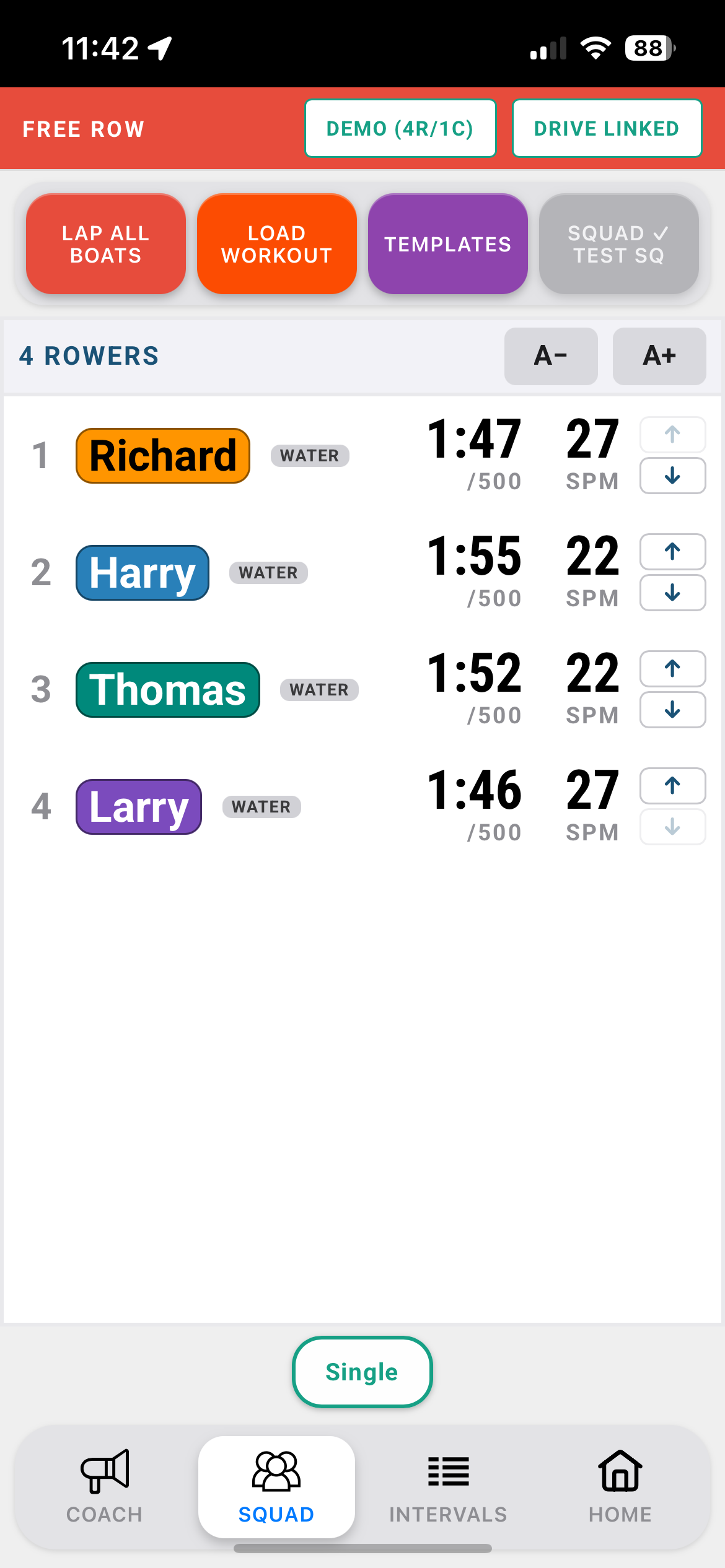
RACE MODE is ideal for monitoring and managing races and interval sessions. This display also shows the lap distance and is rodered by furthest ahead. The relative position is reset to zero between intervals so coach can see if relative results change between intervals.
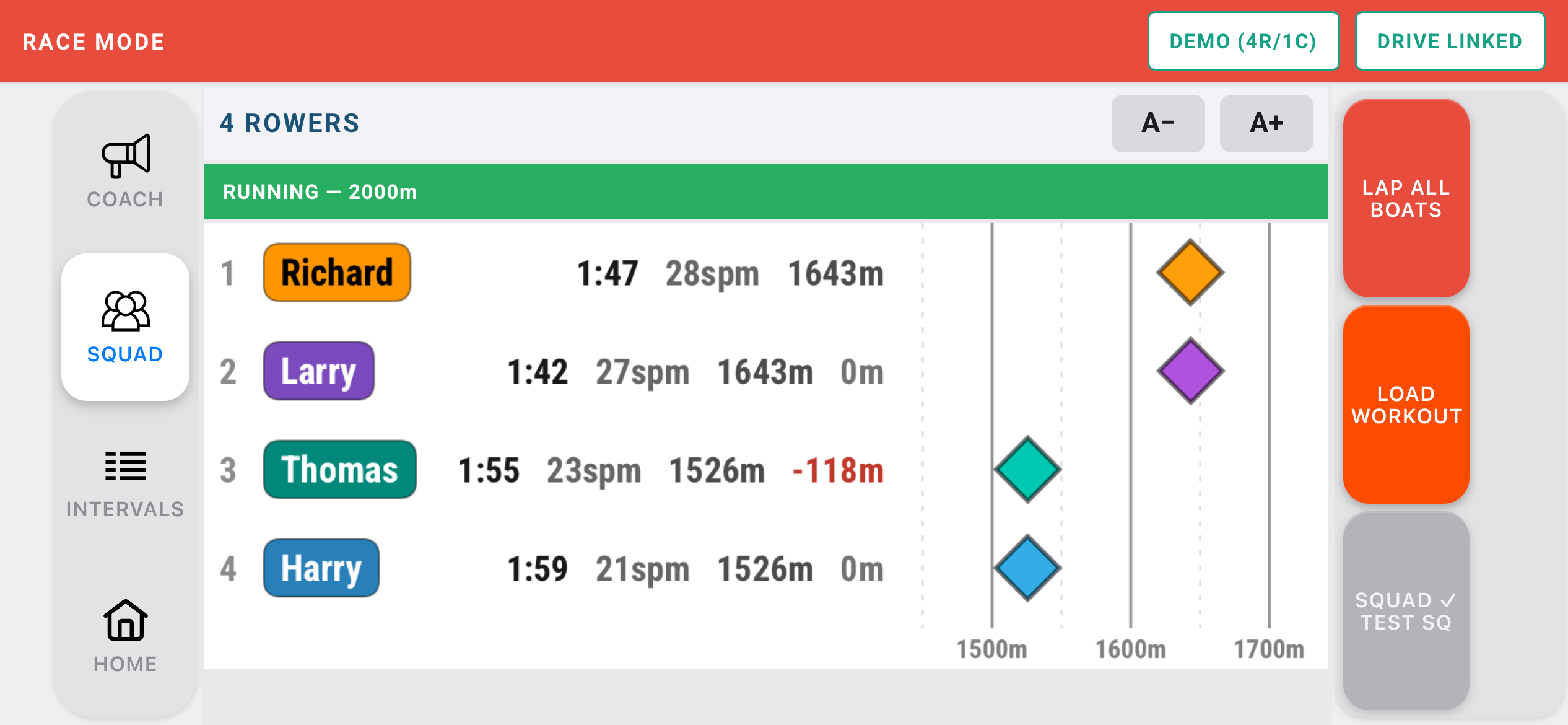
The detailed view of any crew can be entered by tapping their tile.
Rower detail
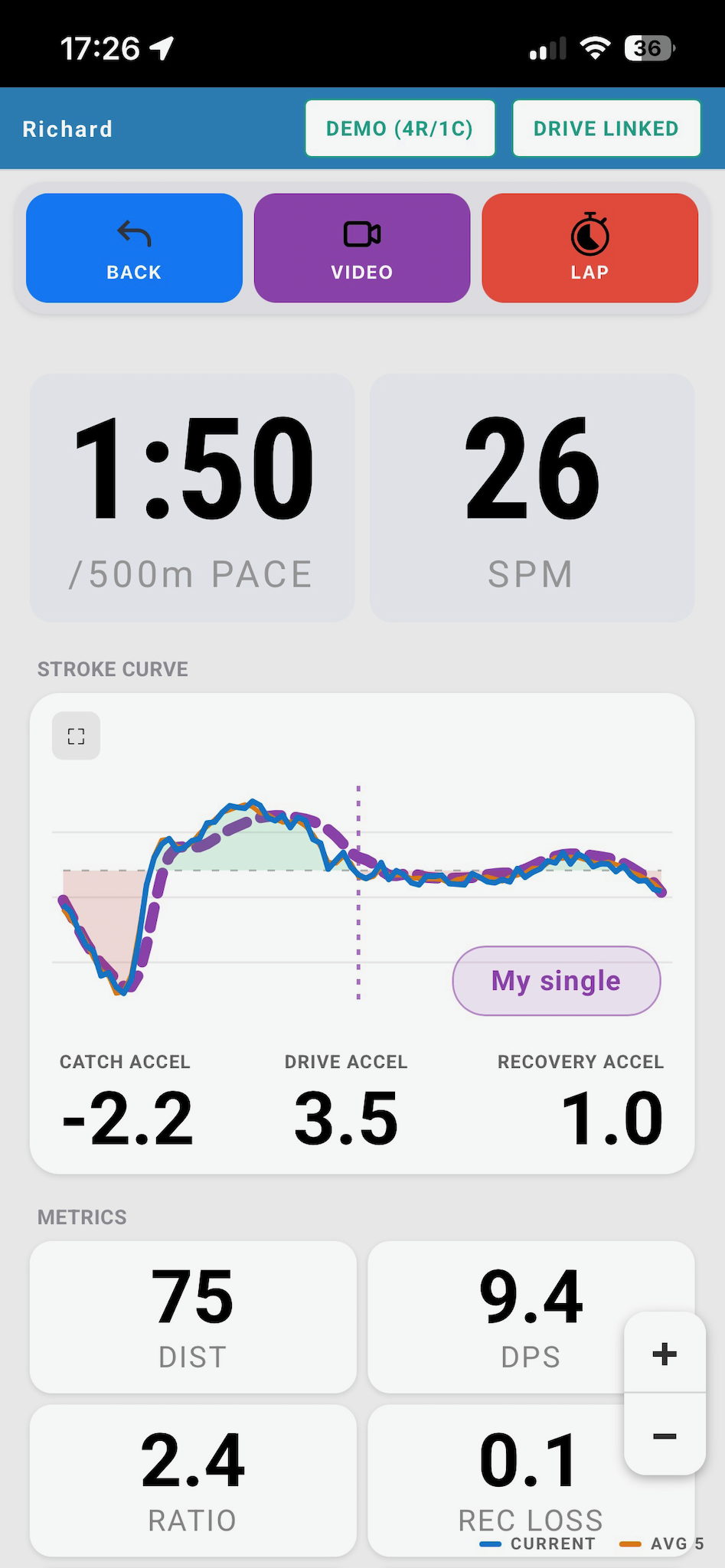
Tap a tile to open it. Full metrics, live stroke curve, mini route map, and a lap button for that rower.
REQUEST CURVE asks that rower's phone to start streaming its stroke curve. It streams for as long as you've set in STROKE CURVE REQUEST LENGTH (5–60 seconds). Longer is smoother but costs battery on the rower's phone, so it's a request rather than something always on.
VIDEO records a clip through the phone camera, tagged to that rower and that moment. The clip can be dropped onto the session later in the Analyser's video overlay. Alternatively, you can just record videos from your phone and import them into the Analyser, however they won't be specifically linked to that rower's file. The save folder can be set in SETTINGS → SYSTEM SETTINGS when in coach mode. The recommended video folder is a cloud synced folder so videos can easily be accessed from the Analyser.
Running a squad erg workout/race
All rowers in your squad can see their relative position on their SQUAD tab when they are pushed the same workout by the coach.
- Rowers do their own warmup. All rowers must have stopped warming up and be on the erg screen main menu to receive the squad workout.
- LOAD WORKOUT - build the piece. A single distance or time piece, a repeated interval, a variable set or your own saved workouts.
- PUSH TO SQUAD Every connected erg is armed with the same piece. Nothing starts yet but the piece loads itself onto each monitor.
- The button becomes START - n/n LOADED so you can see how many monitors are actually ready. It stays amber until all of them are ready.
- Tap START to start everyone together with a count-in of about 17 seconds.
Rowers signed up to the coach plan can also push workouts to their squad via the SQUAD PIECE button using the same controls as the coach
Running a squad erg workout/race
Running a squad workout on the water is the same process as running it on the erg. The difference is that the workouts all contain a warmup step.
When building workouts, choose to start AFTER 5 SEC or WHEN ROWING. After 5 seconds is ideal for a running start where you don't want to stop the entire squad. WHEN ROWING is ideal for practising race starts where you want everyone to be stationary at the start.
When you want to finish the warmup and start the piece, tap the LAP ALL BOATS button. Note that if you have selected the WHEN ROWING option, all crews must be stationary for at least 10 seconds before pressing lap or the lap will start immediately.
Watch the button before you press it. With WHEN ROWING you want it reading LAP READY n/n - light blue, with the full count - which means every boat is stopped and armed. If it still says LAP for some of them, those crews are moving and pressing now would start their piece on the spot. After the lap lands the button turns light green, LAPPED · READY n/n, and stays there until the crews start rowing - that is your confirmation that all of them are sitting on the start line ready to go.
The INTERVALS tab
The coach's interval tab receives the intervals from all connected rowers as they complete each lap and finish their session. The data is updated every 30 seconds but can be refreshed earlier via the refresh button. Results from individual rowers can be removed from the interval tab via the x button. Deleting data from the tab does not delete the data. It is only removed from the display. Your log will automatically collate the information into a session log which can be viewed on the menu - log tab.
New sessions are generated after a break of more than 3 hours or if the type changes. Eg. On-water to erg session. Squad session data can be opened via the analyser's open COACH SESSIONS option.
Battery - read this
Connecting to a squad costs a lot of battery. It keeps a live network connection open for the whole session, on top of GPS, the accelerometer, and a screen that never sleeps.
How often your phone transmits depends on what's happening:
| Situation | Sends every |
|---|---|
| Not rowing | 60 seconds |
| Rowing, coach not detected | 30 seconds |
| Rowing, coach online | 9 seconds |
| Coach has requested your stroke curve | 3 seconds |
| You start, stop, lap, or receive a lap from the coach | Immediately, on top of the above |
The app deliberately backs off when nobody is listening, and it batches samples between sends rather than waking the radio constantly. But a two-hour squad session with a coach connected will use noticeably more battery than the same row on your own - expect up to double the power consumption.
Practical advice:
- Start every squad session at 100%
- Turn the screen brightness down - it's usually the single biggest drain
- Carry a battery pack for long mornings or multiple sessions
- If you don't need live monitoring, don't set a squad code. You can still Send to coach afterwards, which costs nothing during the row.
- The coach's own phone drains fastest of all - it's receiving from everyone
14. Demo modes
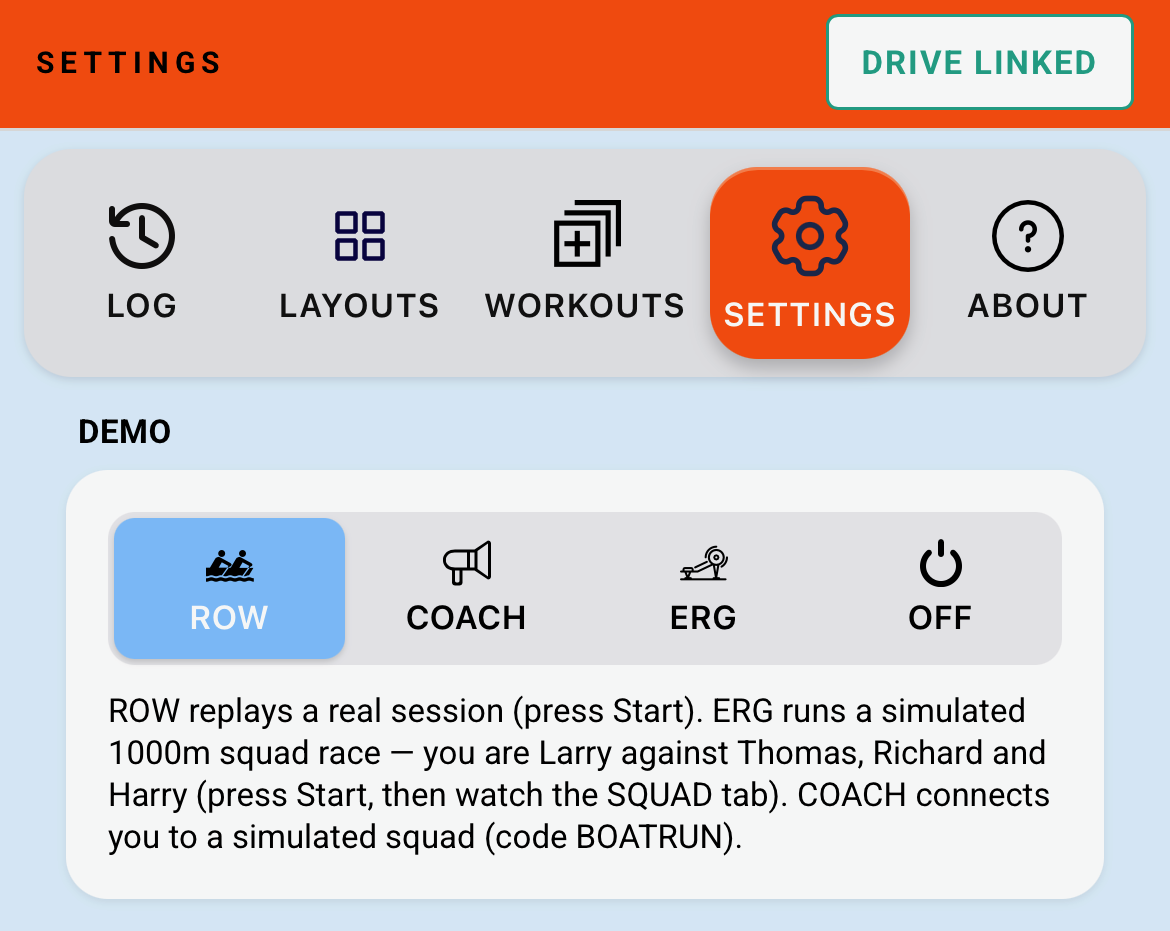
HOME → SETTINGS → ROLE → DEMO
For learning the app on dry land, showing someone what it does, or testing without getting wet.
ROW demo
Set it to ROW, go to the LIVE screen, press Start.
The app replays a real recorded session - genuine stroke data, real curve shapes, real heart rate. Every tile, the curve tab, and the metrics all behave exactly as they would on the water. Nothing is being read from the sensors except the status pills at the top of your display.
Use it to set up your layout, learn what the metrics look like at different rates, or check a workout runs the way you expect.
COACH demo
Set it to COACH and the app connects you to a simulated squad on code BOATRUN - four rowers (Thomas, Richard, Harry and Larry) generating plausible live data every three seconds.
The map, tiles, detail views and curve requests all work. It's the fastest way to see what coach mode does without organising four people and a boat.
ERG demo
Set it to ERG and go to the ERG screen. Press START and see a simulated erg session.
The app will simulate the erg session with relative positions of rowers on the SQUAD tab.
Things to know
- Demo sessions are never uploaded - not to Drive, not to a squad. Nothing you do in demo mode pollutes real data.
- Switching to COACH demo replaces your squad code with BOATRUN. Turn demo off and set your real code again afterwards.
- Row demo only works in Row or Cox role. Coach demo needs Coach role.
- Set it back to OFF before a real row. The app also clears it automatically in most cases, but check.
15. Session log, exports and Sync with Drive
HOME → LOG
Every session, newest first, with distance, duration, pace and a badge reading Synced once the Drive copy is confirmed, or Awaiting Sync until it is. A second badge tracks squad upload if the session belongs to one. Tap a card to open it; swipe it left to reveal DELETE.
Session detail
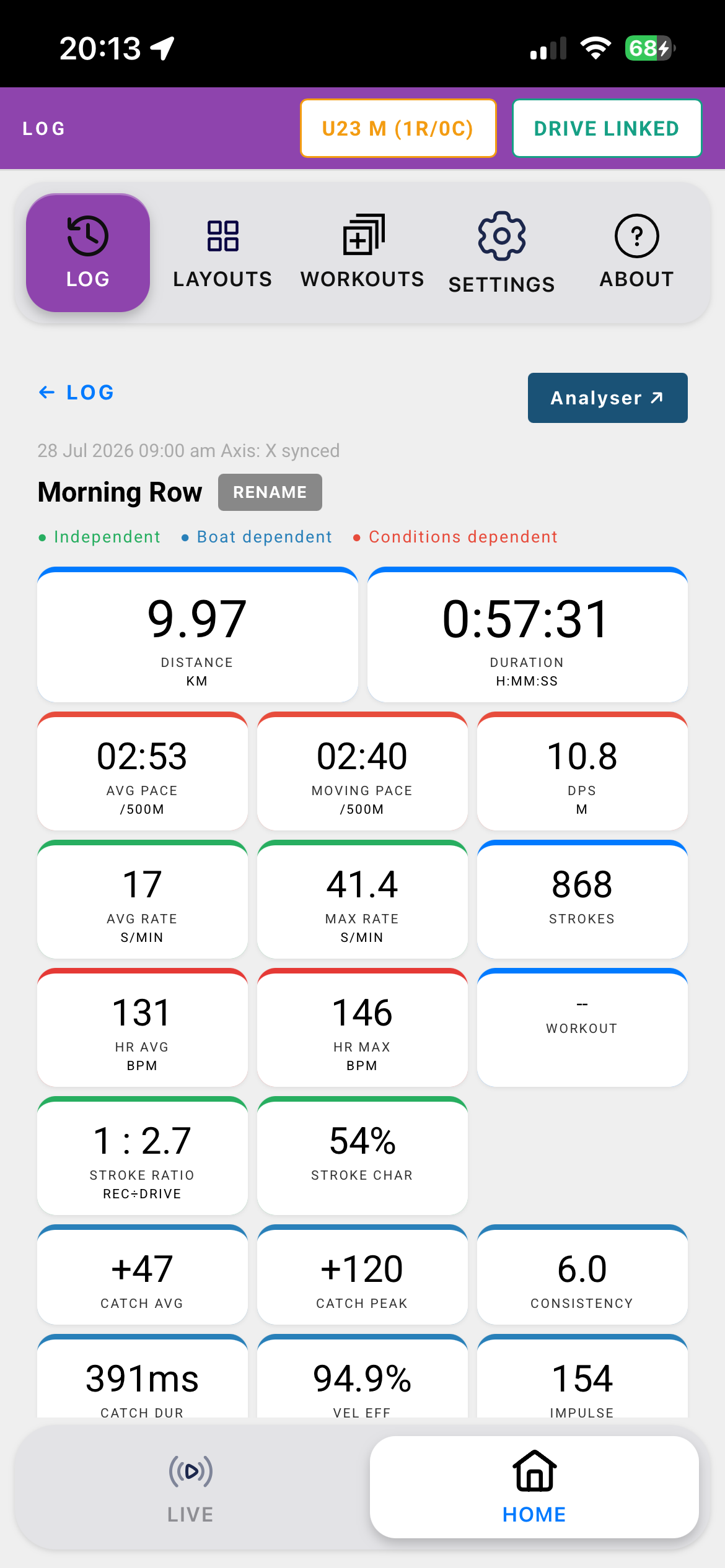
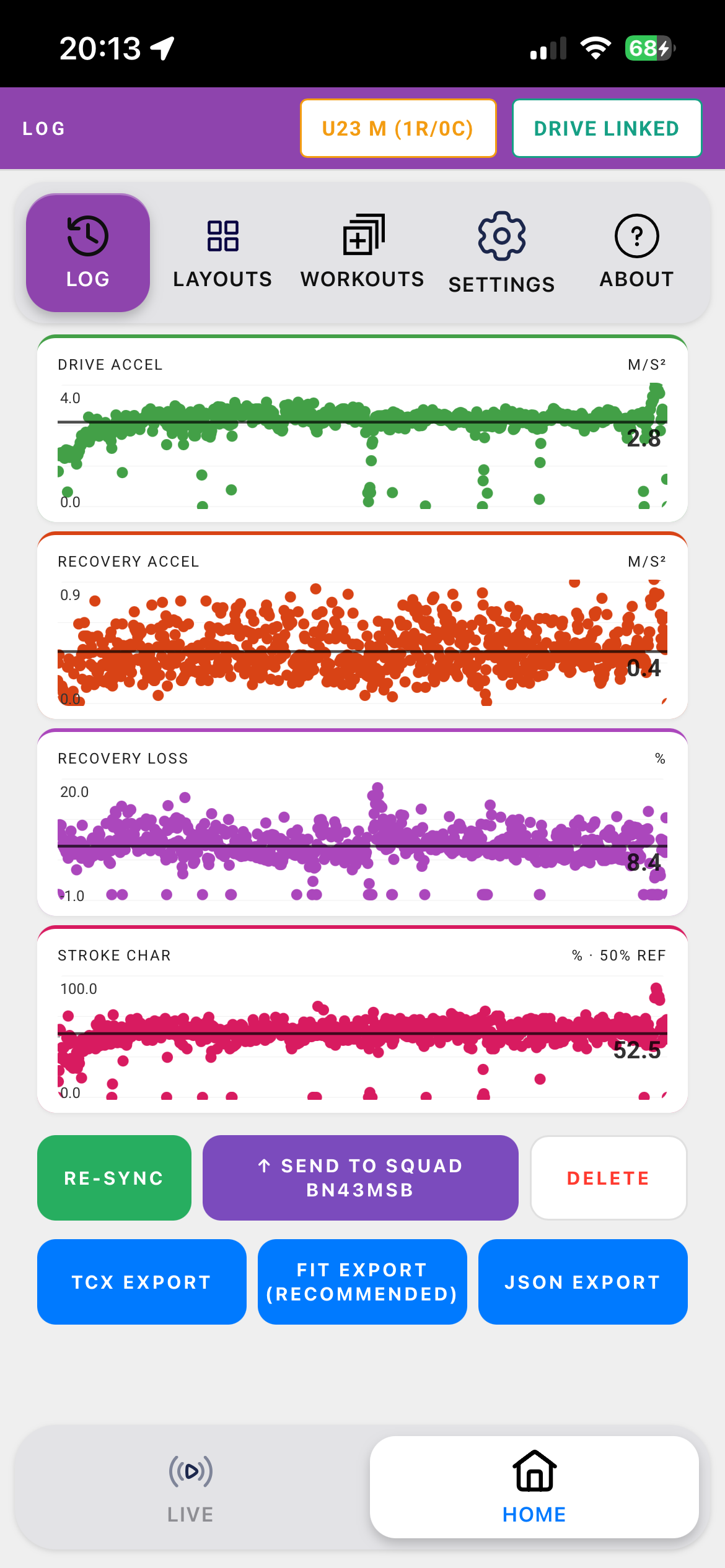
Summary cards, colour-coded by what affects them - green independent, blue boat-dependent, red condition-dependent. Then lap tables, workout interval breakdown if there was one, and charts for every metric.
RENAME gives the session a name, which also updates the Drive copy if it's synced.
Analyser ↗ hands the session straight to the Analyser in a browser.
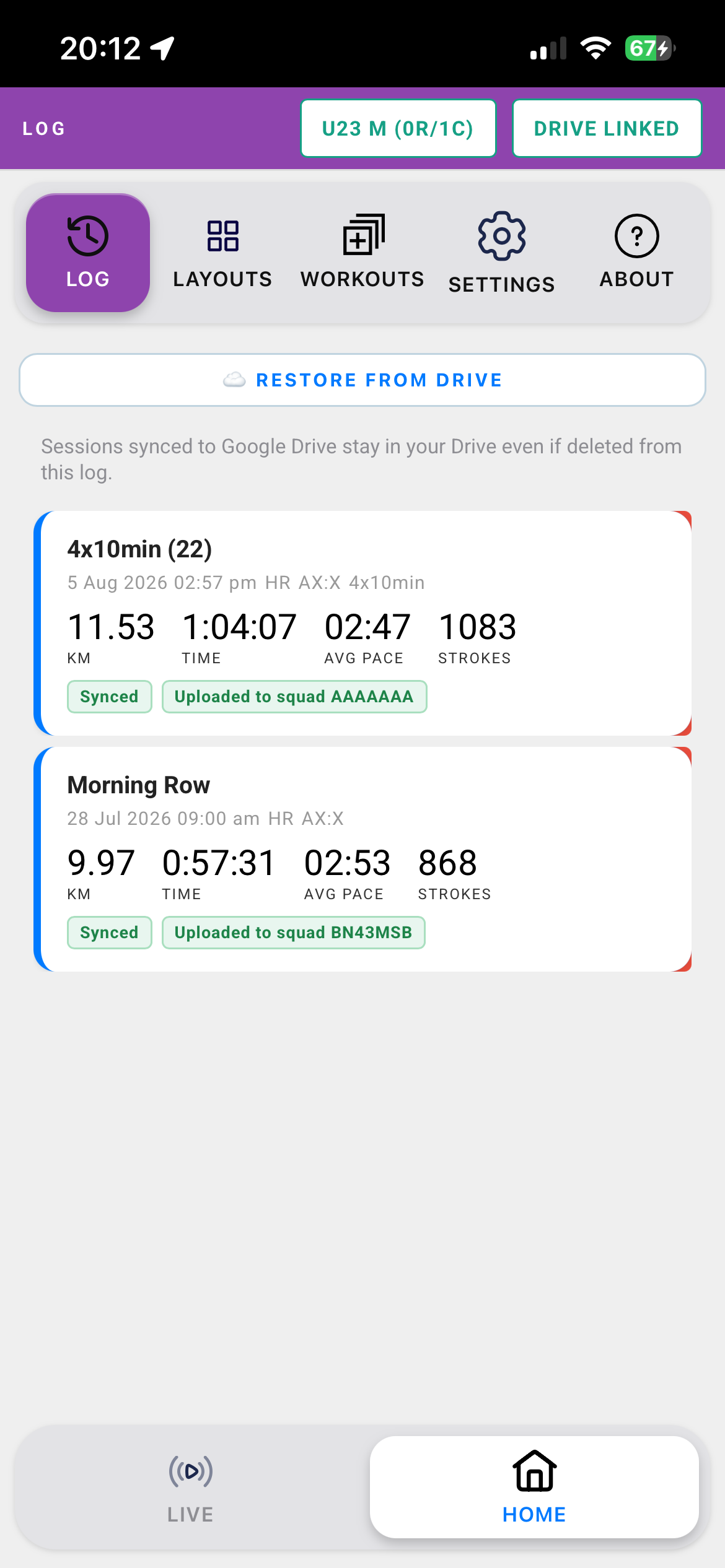
Exports
At the bottom of the session detail.
| Button | What you get |
|---|---|
| Sync to Drive / Re-sync | Uploads this session to your Drive app folder. Turns green once confirmed. |
| Send to squad | Uploads the whole session file to your squad's cloud storage, so your coach can open it in the Analyser. Turns green and shows Uploaded once done. Needs a squad code set. Sessions over about 5MB won't send - use Drive sync for those, or export the JSON and transfer it. |
| TCX Export | Standard training file. Uploads to Strava, Garmin Connect, TrainingPeaks. GPS track plus heart rate. |
| FIT Export (Recommended) | Same destinations as TCX, better fidelity - this is the format Garmin and Strava handle most cleanly. Use this one unless something specifically wants TCX. Garmin Connect on Safari sometimes has difficulty importing FIT files. Recommend using Chrome to import FIT to Garmin Connect. |
| JSON | The complete session - every stroke, every metric, raw traces where present. This is the full-fidelity format and the one the Analyser prefers. |
| Delete | Removes it from this phone, from your Drive, and from every other device. Permanent. See below. |
All exports are free on every tier. Recording it means owning it.
Strava - Pro users who have linked Strava in Settings get automatic upload after every session. No manual step.
Sync with Drive
At the top of the log list: ☁ Sync with Drive. It pulls down every session in your Drive this phone doesn't already have.
You need this because the phone is not the safe copy. Reasons sessions go missing locally:
- You got a new phone
- You reinstalled the app
- The phone reclaimed the app's storage under pressure
Sessions you deleted deliberately will not come back - deleting removes the Drive copy as well, so there is nothing left to fetch.
The first sync on a new phone downloads everything and can take a few minutes; it warns you first and tells you how many sessions are coming. Later syncs are near-instant.
Restore lists everything in your Drive folder that isn't currently on the phone. Tap one to pull it back. Already-present sessions are skipped.
What comes back: the summary, all the charts, the lap and interval tables, and everything needed to re-export as JSON, TCX or FIT.
If restore fails with a storage message, run SETTINGS → YOUR DATA → STORAGE… and free up space first. Don't delete sessions to make room - deleting removes the Drive copy too, which is the thing you are trying to restore from.
Deleting
Deleting anywhere deletes everywhere. Swipe a card left in the log and tap the red DELETE, or use the trash icon in the Analyser, and the session goes from that device, from your Google Drive, and from every other device on its next sync. The confirmation names the session, so a mis-swipe is caught before it does any damage.
There is no undo. The hidden app folder is not Drive's normal bin, so the file cannot be recovered from there afterwards. Delete while offline and the phone copy goes immediately, with the Drive copy removed on your next sync - the app tells you which of the two happened.
Don't delete to free up space. Use SETTINGS → YOUR DATA → STORAGE… instead. That drops only the on-phone copy of sessions already confirmed on Drive - they stay in your log, and download again the moment you open them. See section 6.
The all-or-nothing DELETE MY DRIVE DATA in SETTINGS → YOUR DATA is the only bulk delete.
16. Analyser
The Analyser is a web page. Bookmark it, open it on a desktop for preference or an iPad at a pinch. There's nothing to install.
It reads directly from the same Google Drive folder the app writes to, so anything you've synced is already there.
Getting in

Three ways to load data:
- Connect Google Drive - lists everything in your Drive folder
- From Squad - enter a squad code and pull sessions your rowers have sent (password required if set by coach). This is how a coach reviews the squad's work.
- Open file - a
.json,.fit,.tcxor.csvfrom anywhere.
The Summary Tab
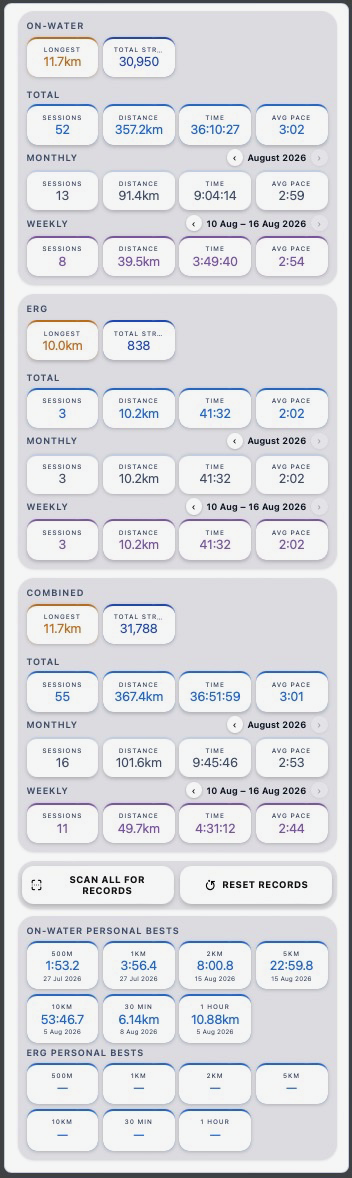
Once signed in, you can view your personal summary of rows and ergs.
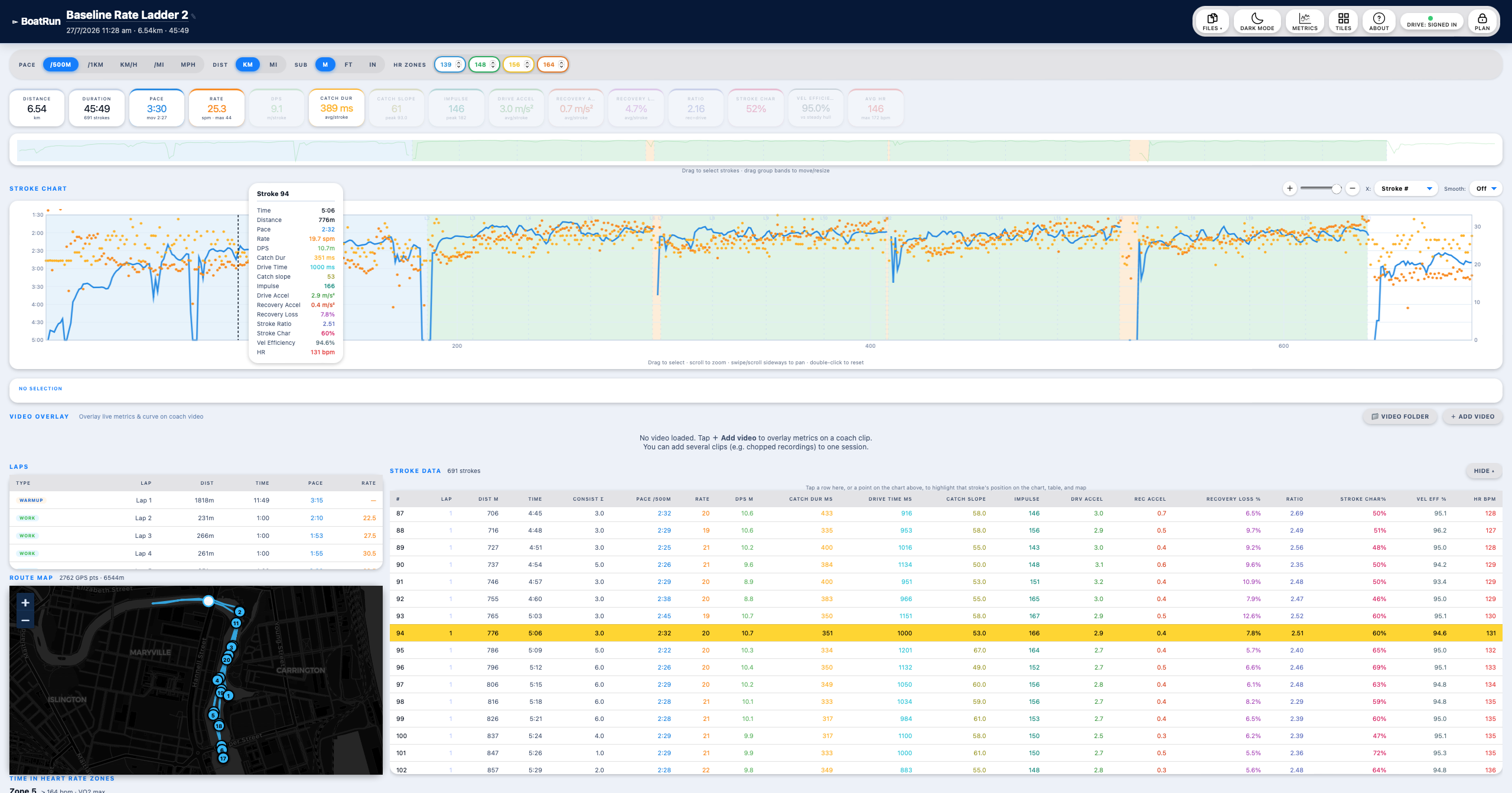
Summary - Longest row and Total Strokes across everything, then Sessions / Distance / Time / Avg Pace for three ranges: all-time, a month you can step back through, and a week you can step back through. Use the ‹ › arrows to move between periods.
Personal Bests - your fastest 500m, 1km, 2km, 5km, 10km, 30min and 1hour ever recorded. These are true rolling best efforts, not lap times: the Analyser slides a window along your GPS trace looking for the quickest that distance was ever covered, anywhere within any session. A 2k PB found in the middle of a long steady row counts.
Tap a PB card to open the session it came from.
Scan All for Records - walks every session in your Drive and rebuilds the PB table. Run this once after you first sign in, and again after uploading a backlog. It takes a while with a large library - the button shows progress.
Reset Records clears them; re-scan to rebuild.
Sessions - the full list, with a trash icon on each for permanent Drive deletion.
Loading a session
Click any session. If you load more than one via the +add for comparison (PRO only), each gets a tab across the top - click a tab to make that session active.
Units bar
Sets pace unit (/500m, /1km, km/h, /mile, mph), distance (km or miles) and DPS sub-unit (m, ft, in). In erg files, options are Pace, Watts or Calories. Applies instantly everywhere - cards, charts, tables. This is synced across your app and logins via your Google Drive.
Summary cards
Across the top: Distance, Duration, Pace, Rate, DPS, Negative Catch Slope, Catch Accel, Positive Catch Slope, Catch Dur, Drive Time, Impulse, Drive Accel, Recovery Accel, Recovery Loss, Ratio, Stroke Char, Vel Efficiency, Avg HR.
Each card is colour-coded by category and clicking a card toggles that metric on or off in the main chart. That's the primary way you control what's plotted.
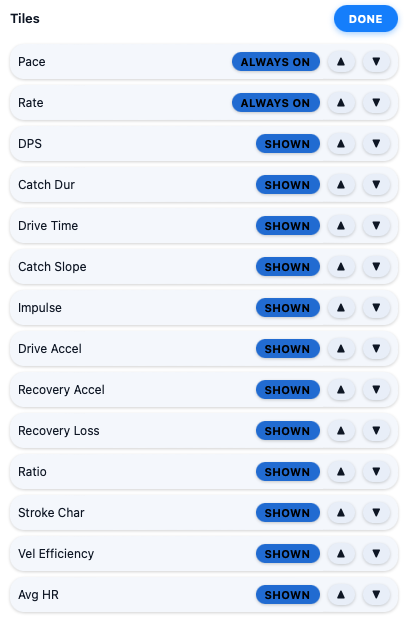
Tiles in the toolbar lets you reorder the cards and hide ones you never use. Pace and Rate are always on.
Metrics in the toolbar opens the full glossary - what each one means and how to read it.
Stroke chart
The main event. Every metric you've enabled, plotted stroke by stroke.
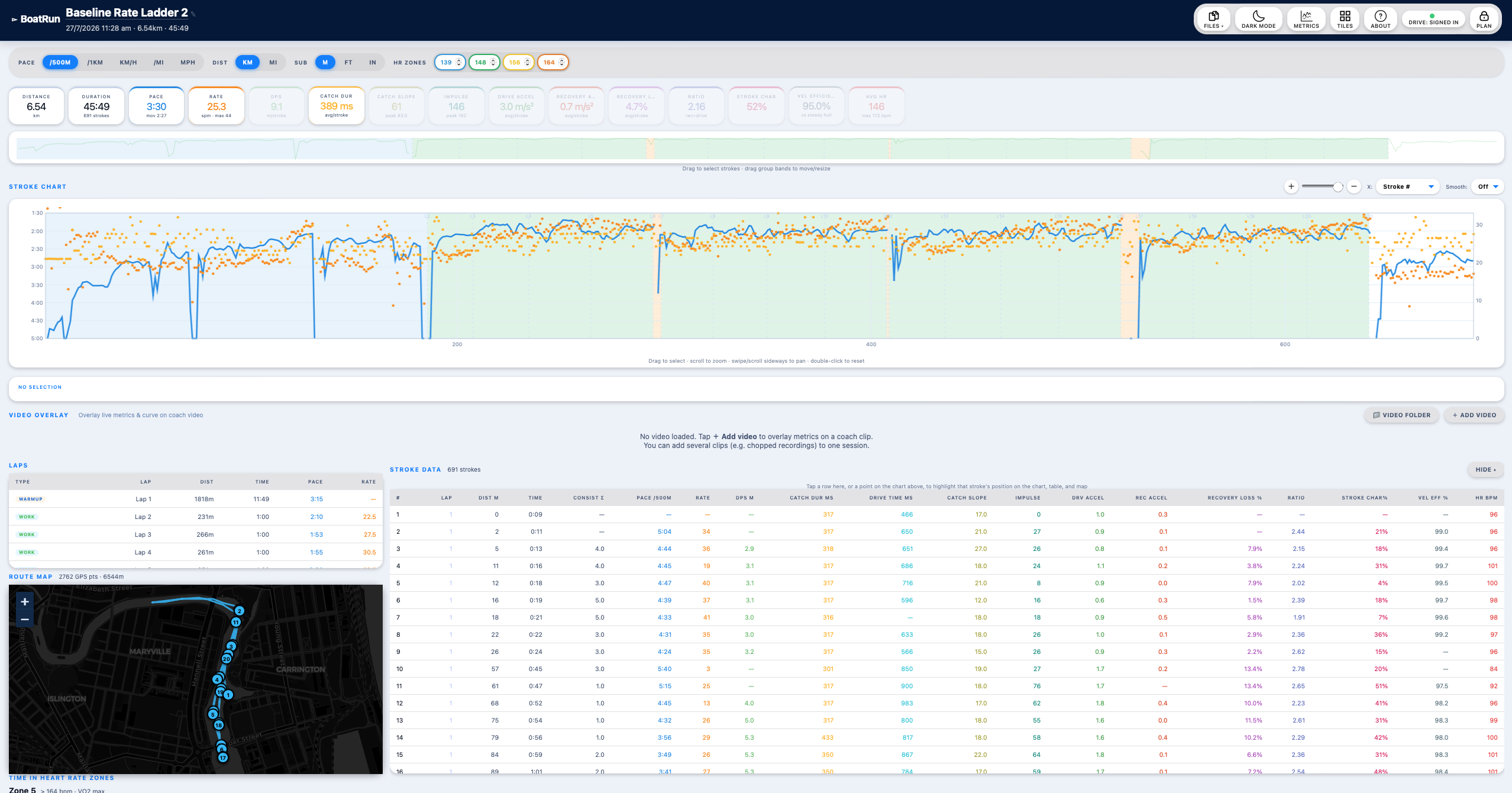
- X axis – by stroke number, distance in metres, or time in minutes
- Smooth - smoothing off (raw data), or smoothed over 3, 5, 10, 15, 20 or 30 strokes. Turn it up to see trends, down to see individual strokes.
- Zoom - the + / − buttons, the slider, or scroll on the chart
- Pan - swipe or scroll sideways, or use the pan slider
- Double-click resets zoom
- Drag across the chart to select a range of strokes
- Hover or tap for every value at the nearest stroke
The overview strip above is a miniature of the whole session. Drag on it to select; drag the coloured group bands to move or resize them.
Stats strip
Sits under the chart. Shows averages for whatever you've got selected, or for the current view if nothing is selected. From here, + Add to curves pins the selection as a curve group.
Curve comparison
This is where the real analysis happens.
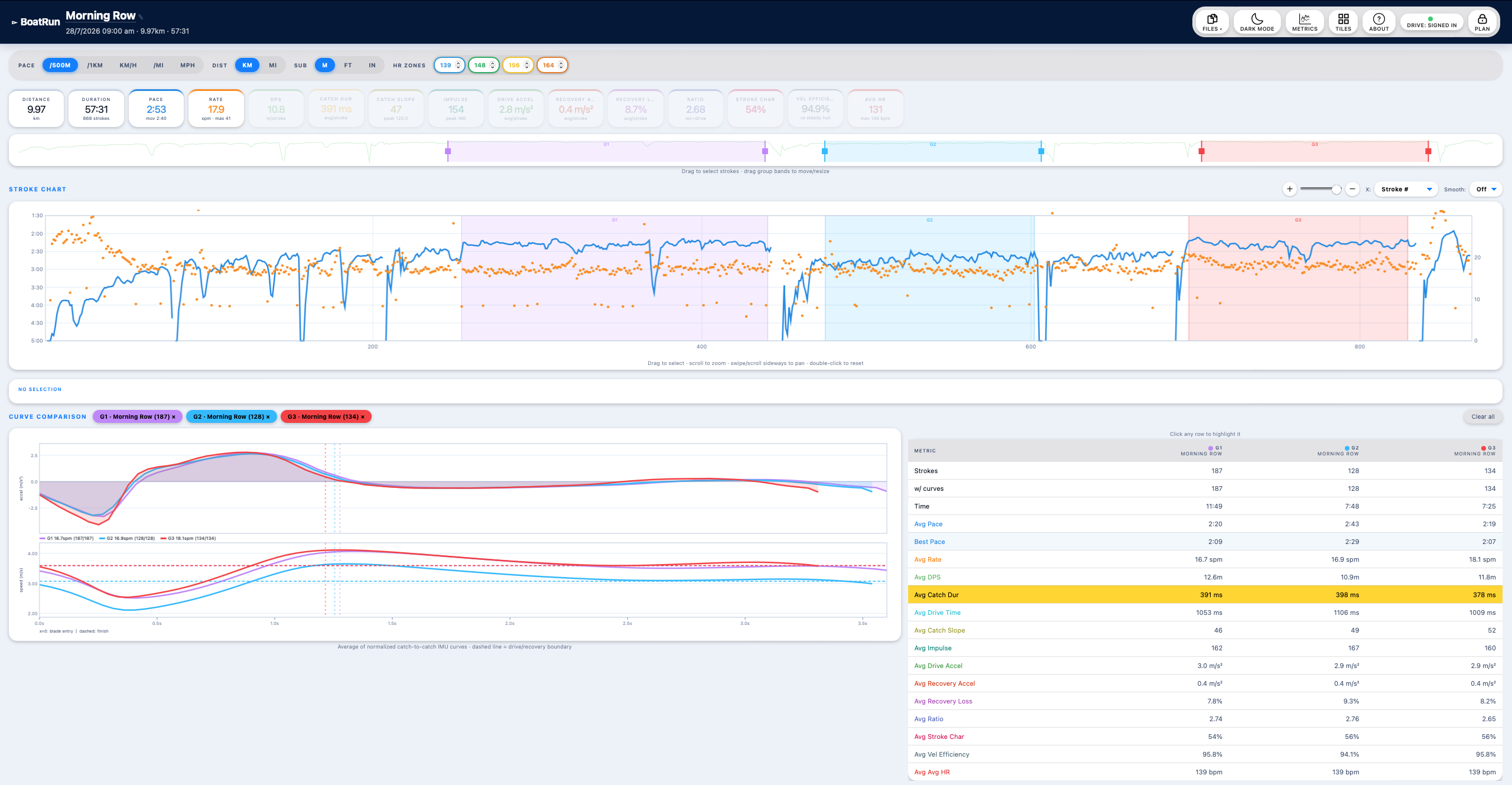
Pin up to 8 groups of strokes (BASIC and PRO) from multiple sessions (PRO only) and their averaged acceleration curves are overlaid on one canvas, time-normalised so the drive phases line up. Underneath each curve is the integrated speed profile - how the boat's speed actually moved through the stroke.
Three ways to pin a group:
- Drag a selection on the chart → + Add to curves
- Click a row in the lap table → the selection is set for you → + Add to curves
- Drag an existing group band on the overview strip to move or resize it
The stats table beside it gives one column per group: stroke count, strokes with curve data, elapsed time, and averages for every metric. Click any row to temporarily highlight it.
Cross-session comparison is the point. Load two sessions, pin a group from each, and compare. The curve shape is derived from the accelerometer and is not affected by wind, tide or current - so unlike pace, curve comparison between two different days is always valid. If the shape changed, your mechanics changed.
Stroke Templates
A stroke template is a set of averaged stroke curves - one per stroke rate - saved as a small JSON file. It becomes a target shape you can draw behind any other curve, in the Analyser or live on the water.
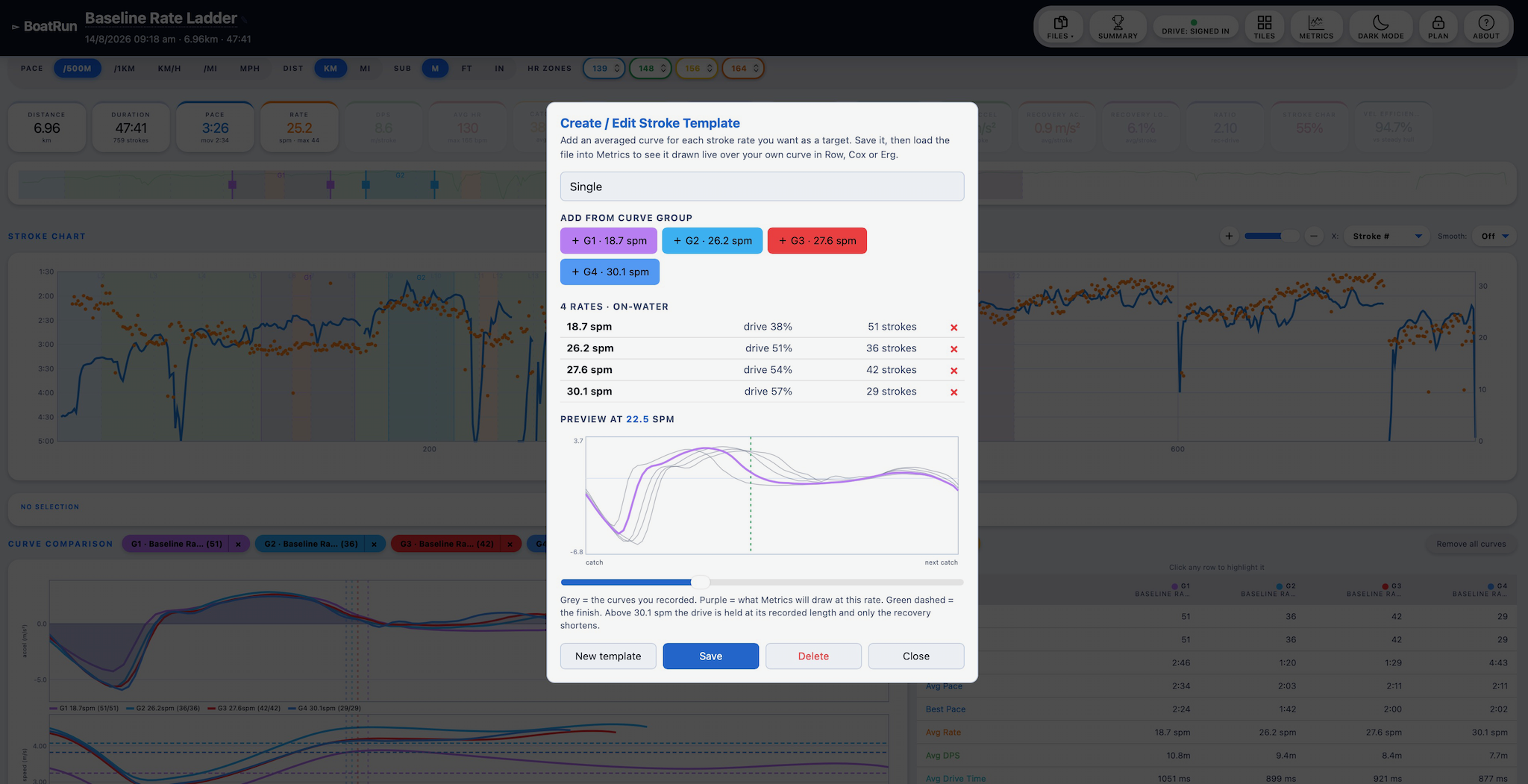
Building one (Pro)
Creating, editing, loading and using templates are all Pro, including drawing one on the video overlay. The only template job that needs Coach is pushing one out to a squad mid-session.
- Drag a selection on the chart over a block of strokes at one steady rate → + Add to curves. Repeat for each rate you want in the template - e.g. 18, 22, 26, 30, 34.
- Click Create / edit template, give it a name.
- Add each pinned curve group in turn. Each one becomes a rate entry showing its rate, its drive percentage and how many strokes it averaged.
- Drag the preview slider to see the template re-timed across the whole rate range before you save.
- Export writes the JSON file.
Between the rates you supplied the shape is interpolated. Above your highest rate or below your lowest, the drive portion keeps its recorded length and only the recovery is stretched or shortened to fill the stroke - which is what actually happens on the water.
Two kinds of template
Templates are either on-water (normalised catch-to-catch acceleration curves, from the phone's accelerometer) or erg force (PM5 drive-force curves). They are different shapes on different axes and never mix. A template built from on-water data will only ever draw over on-water curves, and an erg one only over erg curves.
Using one in the Analyser
Load stroke template opens one or more template files. Click a template chip to make it active - it turns yellow. Then click a curve group's coloured pill to view that group on its own with the active template dotted over it. Click the pill again, or Show all curves, to go back to the normal all-curves view.
Using one in the app
See Stroke templates on the live curve in section 8.
Templates are particular to boat class. A single scull template will not tell you anything useful about a quad or an eight - the hull acceleration signature is completely different. Build one per boat type.
Video overlay (Pro)
If your coach recorded clips in Coach mode, select the cloud drive where the videos were saved.
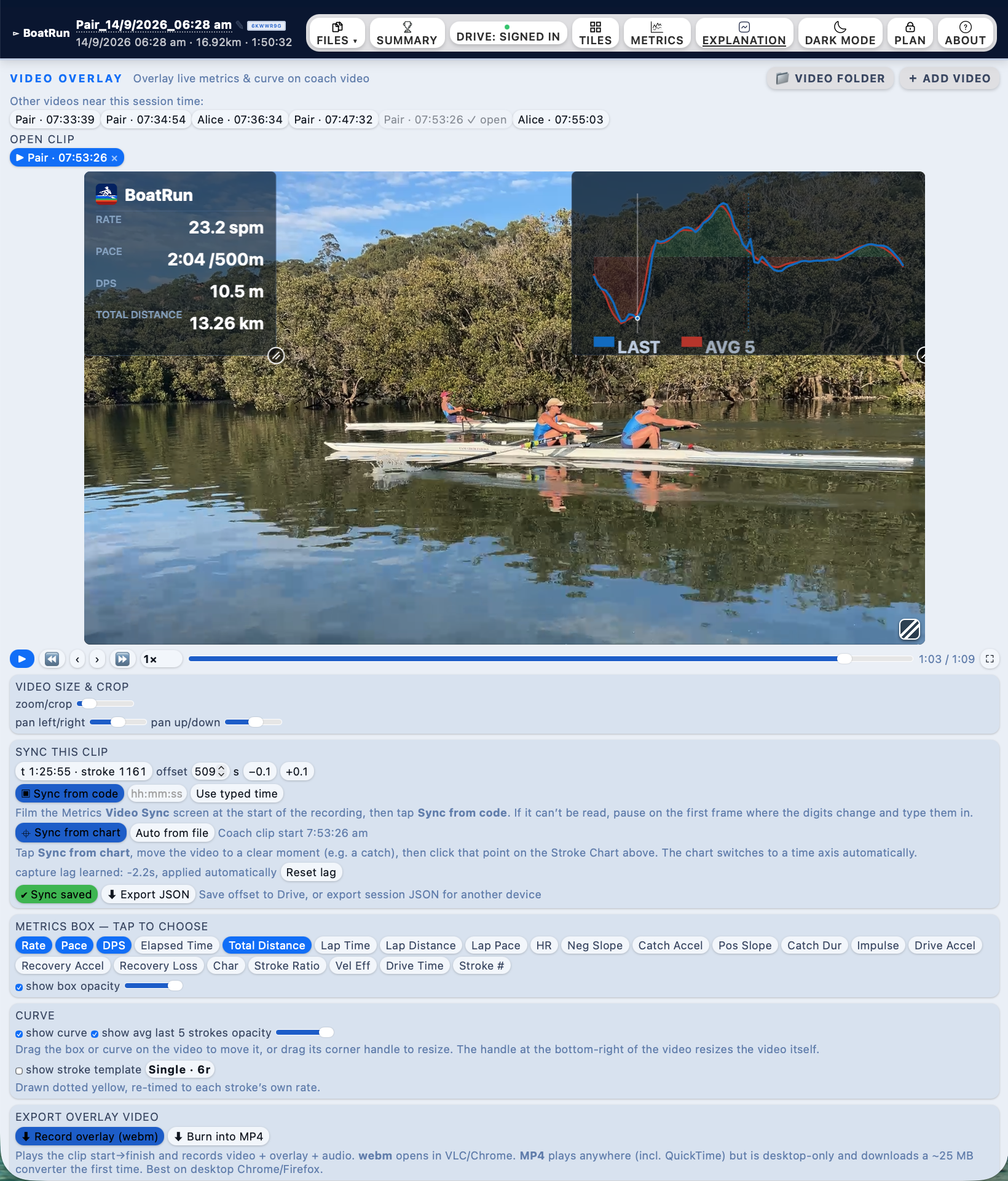
+ Add video for individual files, or Video folder to point at a whole directory - the Analyser matches clips to the session by timestamp and flags the ones it recognises.
- Playback controls with ±5s, ±0.1s frame stepping and fullscreen
- Sync from code reads the Video Sync code filmed at the start of the clip - the most accurate way (see below)
- Sync from chart aligns the video to a specific stroke; Auto from file uses the file timestamp; ±0.1 nudges fine-tune it
- Save sync remembers the alignment
- Once synced, a line tracks across the stroke chart as the video plays, and live metrics plus the stroke curve overlay onto the video itself
- Video size & crop zooms and pans the clip; drag the metrics box or curve to move it, and drag its corner handle to resize
- Metrics box - tap to choose what shows. Rate, Pace and DPS are on by default; your choice is saved to your account. Includes Elapsed Time, Total Distance, Lap Time, Lap Distance, Lap Pace and Workout step when the session has them
- Record overlay (webm = small file) or Burn into MP4 (large file) exports the annotated video
Filming yourself - Video Sync (Pro)
For your own footage from a GoPro, second phone or any camera without a GPS clock. The phone shows its clock as a changing QR code; the camera films it; the Analyser reads it back and lines the video up with your session to within about a tenth of a second. The same clock stamps the session, so it doesn't matter how long you take between showing the code and pressing Start.
On the water
- Start the camera recording
- In Metrics, before calibrating, tap Video Sync
- Hold the phone screen close to the lens, steady, for 3 seconds. Turn the screen brightness up in sunlight
- Tap Done, mount the phone, calibrate and Start as normal
- Keep the camera recording. If you stop and restart it, show the code again
In the Analyser
- Open the session and + Add video
- Tap Sync from code. It searches the first 90 seconds of the clip for the code, then times it to the frame
- If the code can't be read (glare, blur, too far away), step the video to the first frame where the digits under the code change, type that time in (e.g.
07:42:15.5) and tap Use typed time - Check one catch and nudge ±0.1 if needed, then Save sync
GoPro chapters
GoPro splits long recordings into chapters (GX01xxxx, GX02xxxx, ...). There's no gap between them, so the Analyser chains them: sync the chapter with the code and every other loaded chapter of the same recording is lined up automatically, including chapters you add later.
- Load all the chapters up to the one you want - their lengths are needed to chain
- After nudging a chapter, tap Chain chapters to re-line up the rest from it
- If a chapter is missing, or the file times suggest a gap, you'll get a warning - sync that chapter on its own
The QR reader loads from the internet the first time you use Sync from code. Offline, use the typed-time method.
Video format
Best: H.264 MP4 - plays everywhere, including desktop Chrome/Firefox/Safari and export via QuickTime.
Also fine: standard MOV/WebM if H.264-encoded.
Avoid: iPhone HEVC (.mov) - Chrome can't decode it. Android clips are usually already H.264 MP4 and give no trouble. Safari can, but for reliable overlay work across browsers you're best converting HEVC clips to H.264 MP4 first (e.g. via QuickTime "Export As" or HandBrake).
The Coach mode camera picks the best format your device's MediaRecorder supports, in this priority order:
video/mp4;codecs=h264,aac- H.264 MP4 (preferred, and what most iPhone and Android devices give you)video/mp4(generic)video/webmvariants (vp9/vp8, with/without opus audio) - fallback for devices without MP4 recording support
Laps, map and stroke data
Laps - every split. Click a lap row to zoom the chart to it and select all its strokes in one go.
Route map - the GPS track. Pinned curve groups show their segment in the group's colour, so you can see exactly where on the water each comparison came from. A stroke selected in the table shows as a white marker.
Stroke data - every stroke, every metric, sortable by any column. Click a row to pin that stroke; it highlights on the chart and drops a marker on the map. Click again to unpin.
Exporting from the Analyser
Files → Export JSON (to share all data, including the stroke curve, with someone else on BoatRun Analyser), Export TCX or Export FIT (Recommended).
17. Viewer
For spectators, parents, and athletes waiting their turn. No install, no account, no cost - just a link.
- Open the Viewer URL or the QR provided by the coach
- Enter the squad code (BOATRUN to view demo)
- Enter the password (if required)
- CONNECT
You get a full-screen map with every rower as a labelled dot updating live, and a scrollable strip along the bottom with name, stroke rate and pace per rower. Cards grey out when the data goes stale.
Add multiple squads at a time by clicking the + Add another squad button next to the squad code.
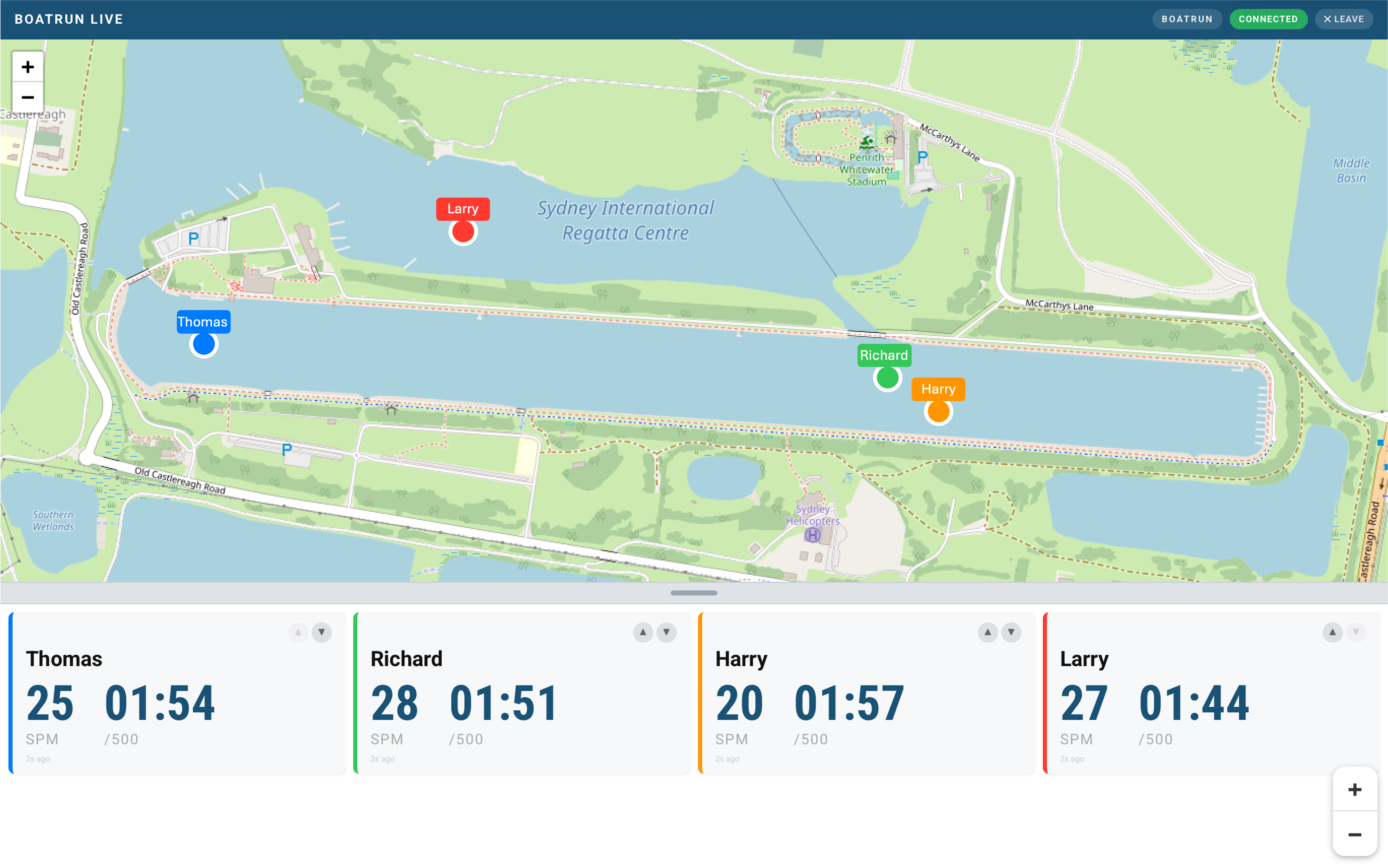
✕ LEAVE to disconnect.
Viewer is always fully free on every tier.
18. Metrics reference
Metrics are colour-coded by what influences them:
- 🟢 Independent - compare across any session, any conditions, any boat. Derived from accelerometer timing.
- 🔵 Boat dependent - a heavier boat gives lower readings for the same force. Compare within the same boat.
- 🔴 Condition dependent - GPS-derived. Tide, current and wind all move the number. Compare only in matched conditions and direction.
🔴 Pace
Boat speed, in your chosen unit. GPS Doppler speed over a sliding window. Suppressed when GPS accuracy is worse than 25m or the boat is barely moving.
Use: interval targets, lap-to-lap comparison within a session. Do not compare across days on tidal water unless conditions and direction match.
🔴 Moving Pace
Pace averaged only over the periods the boat was actually moving. A more honest average for sessions with stationary rests.
Use: the better number for interval training. A big gap between moving and average pace means a lot of time sat still.
🔴 Distance Per Stroke (DPS)
Boat travel per complete stroke cycle. Typically 7–11m in a single scull depending on rate and conditions.
Use: at equal pace, higher DPS means you're achieving it at a lower rating. A mid-session drop at steady rate usually means fatigue.
🟢 Stroke Rate
Strokes per minute, from the median of recent catch-to-catch intervals, backed up by autocorrelation when the catch detector goes quiet.
Use: the control variable for structured work. Clears after a rest and returns after two new catches.
🟢 Stroke Ratio
Recovery time ÷ drive time. Higher means a longer, more relaxed recovery relative to the drive.
- 2.0–2.5 at training rates
- 1.5–1.8 at race rates
Use: the clearest sign of a hurried stroke. If ratio collapses as rate climbs, you're shortening the recovery instead of quickening the drive.
🟢 Stroke Char (%)
Where the peak drive acceleration falls within the drive. 0% = the moment the boat starts accelerating after the catch, 100% = blade exit. The catch deceleration itself is not included - that is Catch Dur. The peak time is interpolated between sensor samples, so it doesn't jump from one sample to the next, and it is smoothed over the last 5 strokes.
- Under 40% - front-loaded
- 40–60% - mid-drive
- Over 60% - back-loaded (or soft/late catch)
Use: rising Char through a session means the catch is going under fatigue. Pair it with Positive Catch Slope as high slope with low Char is clean front-end loading.
Note: sessions recorded before Metrics 260915_3 used the impulse centroid (the balance point of the whole drive curve), which can only read about 33–67% and so sits close to 50% even on a very back-heavy stroke. Don't compare those sessions directly with newer ones.
🟢 Recovery Loss
Speed lost to deceleration during the recovery, normalised per second of recovery so the number is comparable across stroke rates. Accelerometer-derived, condition-independent. Lower is better.
Use: high Impulse with high Recovery Loss means energy is going into deceleration - often the rating is too low for the force you're putting in. Low Impulse with low Recovery Loss is an efficient, consistent drive.
🔵 The catch group
Four metrics describe the same feature of the stroke curve: the check, the trough the hull drops into as the blades go in. Read together they tell you how you entered it, how deep it got, how you came out of it and how long the whole thing lasted.
- Negative Catch Slope the gradient going down into the check
- Catch Accel the depth of the trough
- Positive Catch Slope the gradient coming back out of it
- Catch Dur the width of the trough
Both slopes are reported as positive numbers because they are magnitudes. A larger Negative Catch Slope means a steeper fall, not a shallower one. Catch Accel is the one that reads negative.
🔵 Negative Catch Slope
The steepest rate at which acceleration falls going into the catch, as the blades enter and the hull checks. Short label: Neg Slope. Measured in m/s³.
Use: a high value means the check arrives abruptly. Paired with a shallow Catch Accel that is a sharp, well-placed entry. Paired with a deep Catch Accel it is the boat being stopped rather than caught.
🔵 Catch Accel
The peak backward acceleration at the catch, in m/s² - how deep the check goes. Always a negative number. This is the figure displayed a third of the way in from the left, at the bottom of the stroke curve.
Use: closer to zero is a lighter check and less speed thrown away at the front end. Watch it against Recovery Loss, as both describe boat speed being lost rather than gained. Read off the plotted curve, so the number always matches the trough you can see. Do not compare it across boat classes.
🔵 Positive Catch Slope
How fast acceleration rises out of the catch as the drive load comes on. Higher means a sharper, more aggressive catch. Short label: Pos Slope. Measured in m/s³.
Shown as a rolling average with the session peak alongside.
Use: rising slope as rate increases means you're adapting well. Falling slope means the catch is being sacrificed for cadence. A big gap between average and peak means you can produce a good catch but not repeat it.
🔵 Catch Dur
The width of the check, from the point deceleration reaches 30% of its peak depth until acceleration crosses back through zero. Not the whole drive. Accelerometer-derived and essentially unaffected by boat speed, which makes it unusually readable across a session - rate barely moves it.
Use: shorter can mean a sharper build to peak force, a quicker, more connected catch and not rowing the oar in. It is not a measure of length or full drive time.
🔵 Catch Consistency
Standard deviation of recent Positive Catch Slope values. Lower is more repeatable.
Use: consistency degrading late in a session is an early fatigue signal - it usually shows before pace drops.
🔵 Drive Time
Time from peak drive acceleration to blade exit - the back half of the drive, complementing Catch Dur. Same accelerometer source, so it covers every stroke regardless of GPS.
Use: add it to Catch Dur for a full-drive estimate. Watching the split between the two shows whether you're changing the front or the back of the drive.
🔵 Impulse
Total positive acceleration through the drive, integrated as a change in velocity (Δv). Higher means more drive power delivered to the hull. It's a total, not a peak.
Use: condition-independent measure of how hard the boat got pushed. Impulse rising at constant pace means more effort for the same result. Impulse falling at improving pace means you're getting more efficient.
🔵 Drive Accel
Peak forward acceleration during the drive, catch to finish, in m/s².
Use: the sharp end of the drive. Read alongside Impulse - high peak with modest impulse means a spike rather than a sustained push. This is the figure displayed on the top left of the stroke curve.
🔵 Recovery Accel
Peak forward acceleration during the recovery, measured after the small drag-dip that follows the finish hands away, in m/s².
Use: how much the boat is being pulled toward the rower in the recovery. At high ratings, this figure should be increasing. This is the figure displayed on the top right of the stroke curve.
🔵 Vel Efficiency (%)
Hydrodynamic efficiency of the boat's speed profile within a single stroke. Drag power rises with the cube of speed, so a boat that surges and slows wastes energy against one holding a constant speed.
- 100% - a perfectly steady hull
- 93–97% - typical sculling
Higher is better.
Use: the cleanest single number for run quality. It replaces the old Check Delta, which measured the same underlying thing but as a raw speed swing that meant nothing without context.
🟢 Heart Rate
From a connected Bluetooth strap, with zone colouring.
19. Limitations and warnings
GPS metrics measure over the ground, not through the water
Pace and DPS measure motion relative to the ground. On a tidal river a 0.3 m/s following current improves your displayed pace by roughly 10 seconds per 500m at a 2:00 baseline. DPS is inflated downstream and deflated upstream for exactly the same reason.
The accelerometer metrics - rate, ratio, Stroke Char, Positive and Negative Catch Slope, Catch Accel, Catch Dur, Drive Time, Impulse, Drive Accel, Recovery Accel, Recovery Loss - are unaffected by current. These are your reliable technique metrics on tidal water.
The mount matters more than anything else
Every accelerometer metric assumes the phone is rigidly attached to the hull. Any independent movement corrupts all of them. A mount that rocks near stroke frequency is particularly bad - it corrupts stroke ratio and Stroke Char specifically, and it does so plausibly enough that you might believe the numbers.
Recalibrate whenever you move the phone.
Axis lock after a long rest
Axis lock can drift after a long stop. The AX pill goes orange when unlocked. If it stays orange after several strokes, row steadily for 20–30 strokes to let the detector relock.
Crew boats
In doubles, quads and eights the accelerometer sees all the rowers superimposed. Stroke detection follows the dominant signal, usually stroke seat. At high rates, adjacent catches can trigger false detections. Catch Slope, Catch Accel and Impulse values are not comparable with single-scull values.
No absolute force measurement
These metrics measure the hull's acceleration response to blade force, not the force itself. The same force produces very different accelerations in a single and an eight. Never compare Catch Slope, Catch Accel, Impulse, Drive Accel or Recovery Loss across boat classes.
Cold and battery
Below about 5°C the phone may throttle its CPU or drop the sensor polling rate. Keep it warm before launching. Start long sessions at full charge, and see the battery notes if you're connected to a squad.
Squad features need mobile data
Not Wi-Fi. Squad, Coach and Viewer all need an active mobile connection on the water. Recording is entirely local and continues regardless - the live view is best-effort. Rower tiles grey out under bridges and in poor signal; that's normal.
Protecting your data
- Confirm the synced badge before you rely on Drive as your only copy
- Export JSON immediately after a significant session
- Tap Finish rather than force-closing the app
20. Troubleshooting
Stroke detection not triggering Recalibrate with the phone in the mount and the boat still. If the AX pill stays orange for more than a minute the signal is too weak on every axis - check the mount is rigid and flat.
AX pill shows the wrong axis Settings → SYSTEM SETTINGS → SURGE AXIS → FORCE X or FORCE Y. Only do this if AUTO is genuinely reading it wrong; the automatic pin is correct almost always. The best way to check is watching the stroke curve. If it is significantly wrong, it's probably an axis detection issue.
Pace high, or dropping out GPS accuracy must be better than 25m. Under bridges and near tall buildings it will drop out briefly. On tidal water pace is over-ground speed - that's expected, not a fault.
Recording stopped at 20 minutes Basic tier limit. Upgrade to Pro for unlimited recording.
Tiles say PRO - Upgrade to unlock That metric is Pro-only. The tile stays visible so you can see what's there.
Drive sync failing Check Drive is connected ( ). Pending sessions retry automatically when the connection comes back. Export JSON as a backup if it keeps failing.
Session missing from the phone HOME → LOG → Sync with Drive.
Phone says storage is full HOME → SETTINGS → YOUR DATA → STORAGE…. It reports what BoatRun is using and offers to free space by dropping the on-phone copy of sessions older than 30 days that are already backed up on Drive. Nothing is deleted - they stay in your log and download again when opened.
A session opens slowly, or says it needs signal Its full copy has been freed off the phone and is being fetched from Drive. Anything from the last 30 days is always held whole on the phone, so this only affects older rows.
Deleted a session and want it back You can't. Deleting removes it from Drive and every device at once, which is why both apps ask you to confirm. Export sessions you might want later - raw data export is free forever.
Session still showing in the Analyser after deleting it on the phone Reload the Analyser. The Drive file is deleted straight away, so a refresh clears it - unless you deleted while offline, in which case it goes on your next sync.
HR strap won't connect Wet the contacts, put it on before connecting, and make sure no watch or other app has already claimed it.
No rowers appearing in Coach Every phone needs mobile data, not Wi-Fi. Confirm the squad code matches exactly. Check the connection status in Settings.
Rower tiles going grey No recent data. Check that rower is actually recording and not paused. Intermittent grey under bridges is normal.
Battery draining fast You're probably connected to a squad. See the battery notes.
Android: recording stops when the screen is off or the app is in the background Settings → Apps → BoatRun → Battery → Unrestricted. Samsung phones also need BoatRun removed from Sleeping apps in Device care → Battery → Background usage limits.
Android: HR strap won't pair Android needs Nearby devices permission as well as Bluetooth. Settings → Apps → BoatRun → Permissions → Nearby devices → Allow. Location must also be on — Android ties Bluetooth scanning to it.
Analyser chart looks empty All series may be toggled off - click any summary card to bring one back. Or you're zoomed into a gap; double-click the chart to reset.
No Personal Bests showing Run Scan All for Records on the Analyser home screen.
Strava upload not appearing Pro only, and Strava must be linked in Settings. For a manual upload, export FIT and add it to Strava as an activity of type Rowing.
Found a bug or have an idea? Email feedback from the About screen.